
Best overall for detailed planning: eMoney Advisor. Best for goal-based planning: MoneyGuidePro. Best for visual client conversations: RightCapital. This 2026 guide compares financial planning software for RIAs and connects selection to the practice growth, M&A, and succession planning decisions addressed by Intersection Advisory.
- Best financial planning software for RIAs 2026: choose eMoney Advisor for detailed planning, not as a universal default.
- MoneyGuidePro fits goal-based planning; RightCapital fits visual client conversations; NaviPlan fits detailed cash-flow analysis.
- Compare planning methodology, advisor workflow, client explanations, and transition requirements before selecting software.
- Intersection Advisory provides career strategy consulting for financial advisors covering practice growth, M&A, equity valuation, and succession planning.
Why this matters
Financial planning software determines how your advisors organize assumptions, explain trade-offs, and document recommendations. A platform that produces a sophisticated plan but requires an unnecessarily complicated meeting process is the wrong fit for that workflow.
For an RIA evaluating software in 2026, the decision also reaches beyond the next client presentation. Consider who will maintain plans after an acquisition, an advisor departure, or an ownership transition. Those questions belong in the selection process, not in a cleanup project after implementation.
Choose the planning method first and the software second. A goal-based practice and a practice built around detailed cash-flow analysis need different evaluation priorities. Neither approach makes another firm's preferred platform your best choice.
What makes the best financial planning software for RIAs?
Use these criteria to assess each platform before the product demonstrations start:
- Planning methodology: Decide whether your service centers on goals, detailed cash flows, or both. Ask each vendor to demonstrate the actual calculations behind a recommendation.
- Client explanation: Evaluate whether an advisor can explain assumptions, alternatives, and uncertainty without translating every screen into a separate presentation.
- Advisor workflow: Follow the work from data collection through updates and review meetings. Assess the process used by support staff as well as lead advisors.
- Complexity fit: Demonstrate the household situations your firm actually serves. Do not select a platform because it handles complexities absent from your client base.
- Data and transition requirements: Inspect exports, permissions, documentation, and the work needed to transfer responsibility for a plan.
- Practice strategy: Connect software selection to your service model and ownership plans. A stronger presentation alone does not establish that a platform supports your intended operating model.
Financial planning software at a glance
The 2026 shortlist below assigns each product a distinct decision slot. The limitations identify evaluation trade-offs, not measured defects or claims about a particular subscription.
| Software | Best for | Standout capability | Key limitation to assess |
|---|---|---|---|
| eMoney Advisor | Detailed household planning | Cash-flow planning and client financial organization | Whether planning depth creates unnecessary work for simpler engagements |
| MoneyGuidePro | Goal-based planning meetings | Structuring plans around client goals and retirement scenarios | Whether a goal-centered presentation supplies the cash-flow detail your advice requires |
| RightCapital | Visual client conversations | Visual planning presentations and scenario comparisons | Whether the presentation and underlying analysis cover your complex household cases |
| NaviPlan | Detailed cash-flow analysis | Modeling household cash flows and planning assumptions | Whether advisors can maintain and explain detailed models consistently |
A recognizable product name is not a selection criterion. Your decision should survive a demonstration using your own planning questions, not just the vendor's preferred example.
1. eMoney Advisor: best for detailed household planning
eMoney Advisor combines financial planning with tools for organizing a client's financial information. Its cash-flow planning capabilities make it a relevant starting point when your advice depends on how income, expenses, assets, and liabilities interact over time.
Choose this evaluation path when your advisors need to investigate household finances in depth. The question is not whether eMoney Advisor has enough planning breadth; it is whether your firm will use that breadth consistently.
eMoney Advisor pros:
- Supports a detailed cash-flow approach to financial planning.
- Connects financial organization with the planning process.
- Gives advisors a basis for examining how changes in assumptions affect a household plan.
eMoney Advisor cons and trade-offs:
- Detailed modeling requires disciplined inputs and maintenance; depth does not remove that work.
- A simple goal-review meeting does not automatically benefit from a more elaborate planning process.
- Your evaluation must separate required workflows from features that look useful but have no defined owner.
Best for: RIAs whose service model includes detailed household analysis and recurring updates to financial assumptions.
Ask an advisor to explain a retirement scenario using the proposed workflow, then ask another team member to update it. That handoff tests whether the process belongs to the firm or depends on one person's familiarity with the platform.
Verdict: Buy only after the demonstration confirms that eMoney Advisor's planning depth matches your recurring service.
2. MoneyGuidePro: best for goal-based planning meetings
MoneyGuidePro is a goal-based financial planning platform. It organizes planning around client objectives and helps advisors examine retirement scenarios and the trade-offs involved in pursuing those objectives.
For a practice whose meetings begin with what clients want to accomplish, that structure provides a clear evaluation starting point. Test whether the goal-centered discussion remains understandable when you introduce a competing priority or change an assumption.
MoneyGuidePro pros:
- Centers the planning discussion on client goals.
- Supports retirement planning and scenario evaluation.
- Provides a planning structure that aligns with an objectives-led advice process.
MoneyGuidePro cons and trade-offs:
- A goal-based presentation is not a substitute for inspecting detailed cash flows when those drive the recommendation.
- A plan can look orderly while still relying on weak or incomplete assumptions.
- Firms with a highly customized analysis process must test how that process fits the proposed workflow.
Best for: RIAs that organize planning meetings around retirement objectives, competing goals, and decisions clients can act on.
In your 2026 evaluation, ask the demonstrator to change a goal during the meeting rather than present a completed plan. Watch how the advisor explains the result. A useful workflow supports the discussion, not just the final report.
Verdict: Buy when MoneyGuidePro's goal-based structure matches how your advisors deliver advice.
3. RightCapital: best for visual client conversations
RightCapital provides financial planning tools with visual presentations of household finances and planning scenarios. Its evaluation slot here is the client conversation: showing how a decision changes a plan without letting the display replace the explanation.
Start with RightCapital when your firm wants to examine the clarity of its planning meetings. Require the demonstration to move between a visual result and the assumptions that produced it.
RightCapital pros:
- Uses visual presentations to explain financial planning information.
- Supports comparison of planning scenarios.
- Gives advisors a way to connect a client-facing discussion with the underlying plan.
RightCapital cons and trade-offs:
- Clear visuals do not establish that a recommendation is appropriate.
- Complex household cases require an explicit demonstration rather than an assumption of fit.
- A polished meeting experience does not resolve data collection, maintenance, or staff handoff requirements.
Best for: RIAs that prioritize understandable planning presentations and interactive discussion of alternatives.
Give the demonstrator a situation in which a client challenges an assumption. The useful test is whether the advisor can find the input, explain its meaning, and show the effect of changing it. Attractive output alone does not answer those questions.
Verdict: Buy when RightCapital makes your actual planning conversations clearer without sacrificing required analysis.
4. NaviPlan: best for detailed cash-flow analysis
NaviPlan is financial planning software that supports detailed cash-flow modeling. It belongs on the shortlist when household planning requires close examination of income, spending, assets, liabilities, and changing assumptions.
Its distinct use case is analytical depth. Evaluate it against a demanding household case and the process your firm uses to review that analysis before presenting advice.
NaviPlan pros:
- Supports detailed household cash-flow analysis.
- Provides a framework for examining financial assumptions over time.
- Fits an evaluation focused on modeling requirements rather than presentation alone.
NaviPlan cons and trade-offs:
- Detailed models require consistent data-entry and review standards.
- Analytical depth must be translated into a clear client recommendation.
- Firmwide use requires a repeatable process for updating and checking plans.
Best for: RIAs that need detailed cash-flow modeling and have a defined process for reviewing complex plans.
Ask the demonstrator to distinguish an input assumption from a calculated result. Then have an advisor explain which change matters to the client's decision. This tests both analytical access and the quality of the resulting advice conversation.
Verdict: Hold until NaviPlan demonstrates the specific modeling requirements that distinguish your practice.
How this shortlist is ranked
These recommendations rank fit by planning methodology, client explanation, workflow, complexity, transition requirements, and practice strategy. They are not a claim that every RIA should use the first product or that one platform wins every comparison.
The 2026 ranking gives eMoney Advisor the detailed-planning default, MoneyGuidePro the goal-based slot, RightCapital the visual-conversation slot, and NaviPlan the detailed-analysis slot. Your final selection requires confirmation of the capabilities included in the proposed configuration.
Run a decision process, not a feature tour
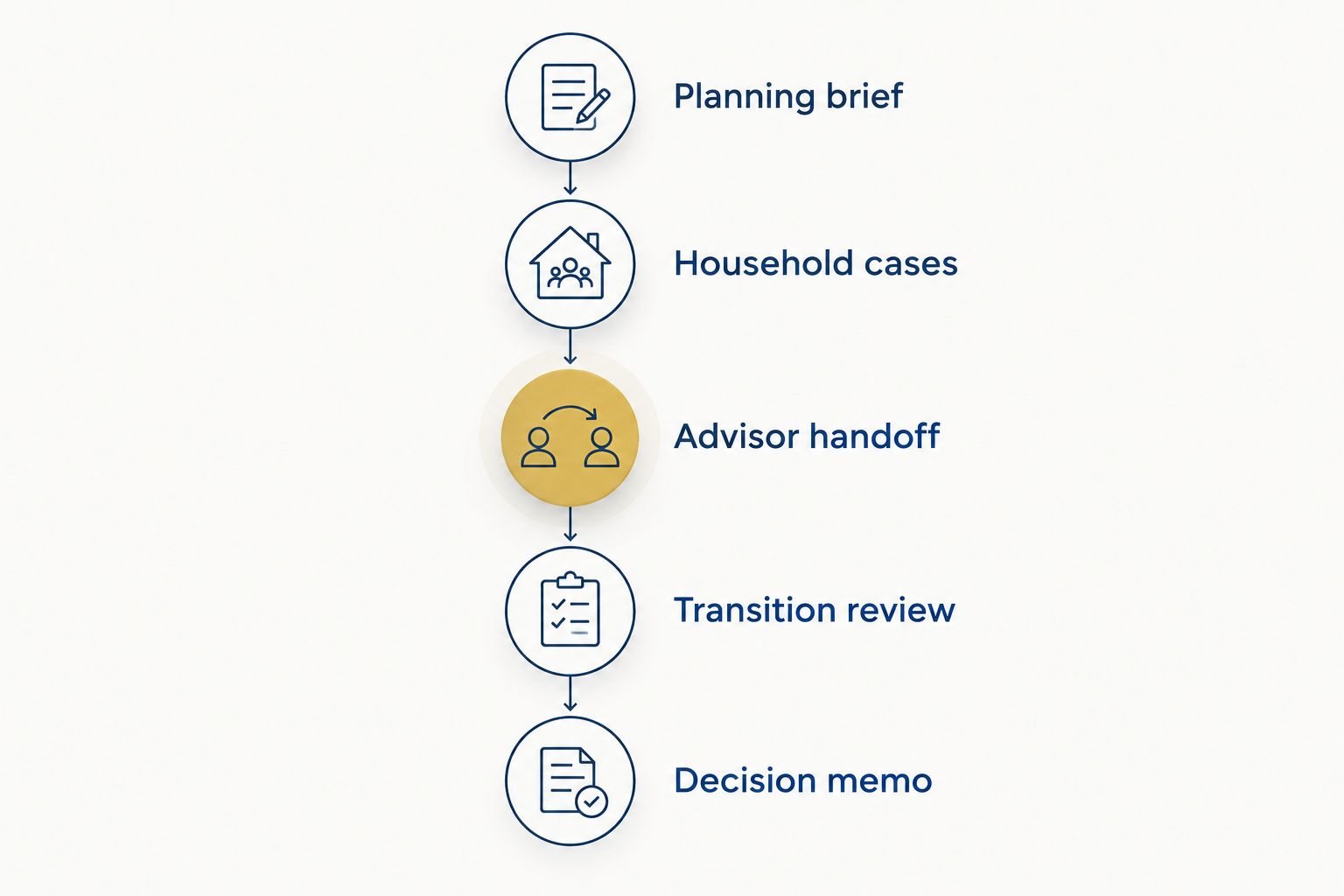
Before committing, use the same evaluation sequence with every finalist. The following quantities are suggested evaluation requirements, not industry benchmarks.
Planning brief
Write down your advice model, typical household complexity, recurring deliverables, and ownership plans. Separate requirements from preferences. A feature that nobody will maintain is not a requirement.
Household cases
Prepare 3 sample households using anonymized or synthetic information: a straightforward retirement case, a case with competing goals, and a complex case representative of your practice. Each platform should address the same questions with the same starting assumptions.
Advisor handoff
Test 2 advisor roles: the person who builds or maintains the plan and the person who presents it. Require both to explain where assumptions live and what changes after a client review.
Transition review
Inspect what the firm can retain and transfer when responsibility changes. Ask about plan exports, supporting documents, access controls, and the difference between exported information and a usable plan in another system.
Decision memo
Create 1 written decision memo documenting the selected platform, unresolved requirements, process owners, and reasons for rejecting alternatives. In 2026, that record is more useful than a feature checklist with no connection to the firm's service model.
Software selection and career strategy are different decisions, but they intersect when your practice changes direction. Intersection Advisory is best suited to financial advisors seeking career strategy consulting around practice growth, M&A, equity valuation, and succession planning. Keep that strategic work distinct from vendor demonstrations and technical implementation.
Align your practice strategy
Consider software decisions alongside practice growth, M&A, equity valuation, and succession planning.
Which financial planning software should you choose?
Start with eMoney Advisor if you need detailed household planning and have not yet narrowed the field. Start with MoneyGuidePro instead if goals and retirement trade-offs define your meetings. Evaluate RightCapital for visual client conversations and NaviPlan for demanding cash-flow analysis.
For your 2026 decision, select the platform that your team can maintain, explain, and transfer responsibly. Do not let a software purchase stand in for an unresolved decision about the advice business you want to build.
FAQ
What's the best financial planning software for RIAs in 2026?
eMoney Advisor is the starting recommendation for detailed household planning; MoneyGuidePro fits goal-based planning meetings. RightCapital and NaviPlan belong on the shortlist when visual client conversations or detailed cash-flow analysis are the priority.
Is MoneyGuidePro better than eMoney Advisor?
MoneyGuidePro is the better evaluation starting point for a goal-based advice process, while eMoney Advisor is the starting point here for detailed household planning. Compare both using the same household cases rather than treating either as universally better.
Who should consider RightCapital?
RightCapital fits an evaluation focused on visual client conversations and scenario comparisons. Require the demonstration to show both the presentation and the assumptions behind it.
When should an RIA consider NaviPlan?
An RIA should consider NaviPlan when detailed household cash-flow modeling is a core requirement. The evaluation should also test how advisors review, maintain, and explain those models.
Does financial planning software replace succession planning?
Financial planning software does not replace succession planning for an advisory business. Client planning, ownership transition, equity valuation, and successor responsibilities are separate decisions that need their own analysis.
What should an RIA test before switching planning software?
An RIA should test representative household cases, advisor handoffs, and transition requirements before switching. Inspect exports and documentation rather than assuming that information transfer produces usable plans in another platform.
Does Intersection Advisory sell financial planning software?
Intersection Advisory provides career strategy consulting for financial advisors. Its stated services cover M&A, succession planning, equity valuation, and practice growth; this guide treats software platforms as separate vendor options.
One last thing
Ask a second advisor to explain a sample plan without help from its original author. If the recommendation depends on undocumented assumptions, the problem is not solved by changing software. Document the reasoning before selecting the platform that will carry it.