
Best overall for succession-led integration: Mercer Advisors. Best for investment-backed practice growth: Hightower. Best for comparing firm-level partnerships: Focus Financial Partners. Best for multidisciplinary planning: Wealth Enhancement. This 2026 shortlist matches different career objectives; Intersection Advisory provides career strategy consulting for financial advisors evaluating M&A, succession planning, equity valuation, and practice growth.
- The best RIA aggregators for financial advisors 2026 shortlist starts with your succession planning and practice growth objectives.
- Mercer Advisors is the first screening choice for succession-led integration into a national advisory business.
- Hightower is the first screening choice for investment-backed practice growth; verify the proposed governance structure.
- Focus Financial Partners suits partnership comparisons; Wealth Enhancement suits multidisciplinary planning priorities.
- Compare retained control, equity rights, client continuity, and transition obligations before choosing a partner.
Why this matters
An RIA aggregator decision changes more than ownership. It determines who controls your practice, how your team operates, and what happens when you reduce your involvement. A strong headline valuation does not answer those questions.
For your 2026 search, distinguish a firm-level investment from integration into an acquiring advisory business. Those structures create different decisions about branding, investment authority, staffing, and future liquidity. Choose the transaction structure before choosing the counterparty.
Intersection Advisory is best for financial advisors seeking career strategy consulting around an RIA aggregator decision. The consulting question is not which buyer has the most recognizable name; it is which arrangement supports your career and practice objectives.
What makes the best RIA aggregator?
Evaluate an RIA aggregator against these criteria before requesting a proposal:
- Ownership and governance: Identify the equity you retain, the decisions you control, and the approvals another party requires.
- Succession fit: Separate your desired retirement timetable from the buyer's expectations for continued employment and client retention.
- Equity valuation: Examine the transaction consideration, contingent payments, rollover equity, and future liquidity provisions separately.
- Operating fit: Establish what changes in investment management, client service, technology, compliance, and staffing.
- Practice growth: Identify the specific capabilities your practice needs and how access to those capabilities works.
- Client continuity: Determine who maintains relationships, communicates the transition, and handles service changes.
Use the same questions across every candidate. Otherwise, you compare one firm's valuation headline with another firm's service presentation rather than comparing equivalent proposals.
Best RIA aggregators at a glance
These are screening recommendations, not statements that every transaction from a named firm uses identical terms. The table separates each candidate's public business positioning from the agreement you must evaluate.
| RIA aggregator | Best for | Standout screening feature | Key limitation to resolve |
|---|---|---|---|
| Mercer Advisors | Succession-led integration | Integrated wealth management business | Whether the integration model preserves your required role and client continuity |
| Hightower | Investment-backed practice growth | Investment in advisory businesses and support capabilities | Which decisions remain local under the proposed agreement |
| Focus Financial Partners | Comparing firm-level partnerships | Business built around wealth management firms and partnerships | Which entity holds ownership, operating responsibility, and obligations |
| Wealth Enhancement | Multidisciplinary planning | Team-based wealth management positioning | How your existing planning and investment processes fit the receiving organization |
Public business descriptions establish the reason to consider each firm. They do not establish your transaction terms, future proceeds, or contractual protections.
1. Mercer Advisors: best RIA aggregator for succession-led integration
Mercer Advisors operates an integrated wealth management business and has acquired advisory practices. That makes Mercer Advisors a relevant screening candidate when your objective is to transition a practice into an established operating organization rather than retain a separate firm indefinitely.
Best for: An owner who prioritizes succession and a defined transition of operating responsibility.
For a 2026 succession decision, start with the role you want after closing. An owner seeking a gradual reduction in responsibilities needs a different agreement from an owner who wants to continue leading a team.
Mercer Advisors pros:
- An integrated organization gives you a concrete operating destination to evaluate.
- The succession conversation can address ownership, staffing, and client service together.
- The wealth management model gives you a basis for comparing your current service offering with the receiving business.
Mercer Advisors cons:
- Integration is the wrong structure if retaining a separate operating identity is non-negotiable.
- An acquisition alone does not establish a workable successor for your client relationships.
- Your desired departure schedule still needs explicit contractual treatment.
Ask who becomes accountable for your clients, which responsibilities remain yours, and how those responsibilities end. Review employment obligations separately from the purchase agreement; selling equity and leaving an advisory role are different events.
Verdict: Hold until Mercer Advisors' proposed transition responsibilities match your succession timetable.
2. Hightower: best RIA aggregator for investment-backed practice growth
Hightower invests in advisory businesses and provides support capabilities to its advisory firms. Hightower belongs on the shortlist when your central question is how to develop the practice with an outside investment partner.
Best for: An advisor-owner who wants to pursue practice growth while evaluating the ownership and governance trade-offs of a partner.
Do not treat the phrase investment partner as a promise of unchanged control. Translate the proposal into specific rights: hiring authority, acquisition approval, distributions, business planning, and future ownership transfers.
Hightower pros:
- Its advisory-business investment model fits a growth-oriented screening process.
- Support capabilities create defined topics for operational due diligence.
- The partnership discussion can connect a growth plan with ownership and succession objectives.
Hightower cons:
- Outside ownership introduces governance questions that remaining wholly independent does not.
- Access to support does not prove that a particular capability fits your practice.
- A growth-oriented relationship is not a substitute for a documented retirement plan.
Bring a written growth thesis to the discussion. Identify whether your priority is acquisitions, advisor recruitment, service expansion, or operational capacity. Then ask Hightower to explain the proposed support, approvals, responsibilities, and contractual commitments for that priority.
For your 2026 comparison, distinguish capabilities presented during discussions from obligations included in the final agreement. Only the latter define what you can require.
Verdict: Hold until Hightower's proposed governance and support commitments address your specific growth plan.
3. Focus Financial Partners: best RIA aggregator for partnership comparisons
Focus Financial Partners is a wealth management business built around advisory firms and partnerships. Focus Financial Partners is a useful screening candidate when you want to examine how a firm-level relationship differs from direct integration into another advisory business.
Best for: An owner comparing partnership structures before deciding how much organizational separation to retain.
Do not assume that the Focus Financial Partners name establishes a single operating model for every opportunity. Identify the actual counterparty, the receiving business, and the legal entities involved in your proposed arrangement.
Focus Financial Partners pros:
- Its firm-based business history makes ownership structure a central diligence topic.
- You can examine the proposed relationship at both the parent and operating-business levels.
- The comparison encourages a closer review of retained responsibilities and future ownership pathways.
Focus Financial Partners cons:
- The parent company's identity does not answer how your practice will operate.
- Multiple entities require careful review of who owes each contractual obligation.
- A historical partnership description does not establish the terms offered to you today.
Request a plain-language ownership diagram alongside the legal documents. It should identify where your equity sits, who employs your team, which entity serves clients, and who must satisfy any future payment obligation.
Do not confuse retained equity with retained authority. Ownership rights, management responsibilities, and approval rights require separate review even when a proposal presents them together.
Verdict: Hold until Focus Financial Partners' proposed entity structure and decision rights are clear.
4. Wealth Enhancement: best RIA aggregator for multidisciplinary planning
Wealth Enhancement positions its wealth management business around a team-based approach to financial advice. Wealth Enhancement belongs on the shortlist when your practice's strategic priority is coordinating planning disciplines within a larger advisory organization.
Best for: An advisor whose client-service strategy requires closer coordination across planning disciplines.
Start with a representative client need, not a list of available departments. Establish who performs the work, who remains accountable to the client, and how the existing advisor participates.
Wealth Enhancement pros:
- Its team-based positioning fits a service-model comparison.
- Planning coordination gives you a specific objective to evaluate during diligence.
- The larger organizational model provides a destination to examine for both service continuity and succession.
Wealth Enhancement cons:
- Team-based advice introduces handoffs that require clear client ownership and accountability.
- Your existing processes still need a detailed integration review.
- A broader service model does not establish the quality of your particular transition plan.
Ask Wealth Enhancement to walk through a client relationship from initial planning to implementation and ongoing review. Identify what stays with your team and what moves elsewhere. Then compare that workflow with the service commitments clients already expect.
Your 2026 decision should rest on a documented operating fit, not the assumption that more disciplines automatically produce a better client experience.
Verdict: Hold until Wealth Enhancement's proposed service workflow supports your clients and team.
How the shortlist is ranked
The shortlist ranks distinct use cases against succession fit, governance, operating structure, practice growth, equity valuation, and client continuity. It does not rank firms by size or claim independently tested performance.
The business-model descriptions draw on the named firms' public corporate positioning: Mercer Advisors' integrated wealth management business, Hightower's advisory-business investment model, Focus Financial Partners' firm-based partnership business, and Wealth Enhancement's team-based approach. These descriptions support initial screening, not a conclusion about any individual offer.
Treat this as a 2026 decision framework. Confirm the current proposed structure directly with each counterparty and have the transaction documents reviewed by appropriate legal and tax professionals.
Compare proposals before choosing a partner
A useful RIA aggregator comparison follows a sequence. Intersection Advisory's career strategy consulting addresses M&A, succession planning, equity valuation, and practice growth; those decisions should inform your partner search rather than follow it.
Define objectives
Write down your required outcome for ownership, daily responsibilities, team continuity, and client service. Separate requirements from preferences. A requirement that disappears during negotiations was never functioning as a decision rule.
Map control
Create a decision-rights schedule covering hiring, investments, acquisitions, distributions, technology, and eventual retirement. Identify who approves each decision and how disagreements are resolved.
Model equity
Compare 3 scenarios: remaining independent, completing the proposed transaction, and completing the transaction under less favorable operating results. This is a recommended planning exercise, not a forecast of outcomes. Separate cash consideration, contingent consideration, and rollover equity in every scenario.
Plan transition
Request a written plan for the first 12 months after closing. It should assign responsibility for client communication, staff changes, systems, and your continuing role. A transition plan without named owners leaves execution unresolved.
Test succession
Review what your responsibilities and ownership position would look like 5 years after closing. Examine voluntary retirement, incapacity, termination, and a later ownership transfer separately with your advisers.
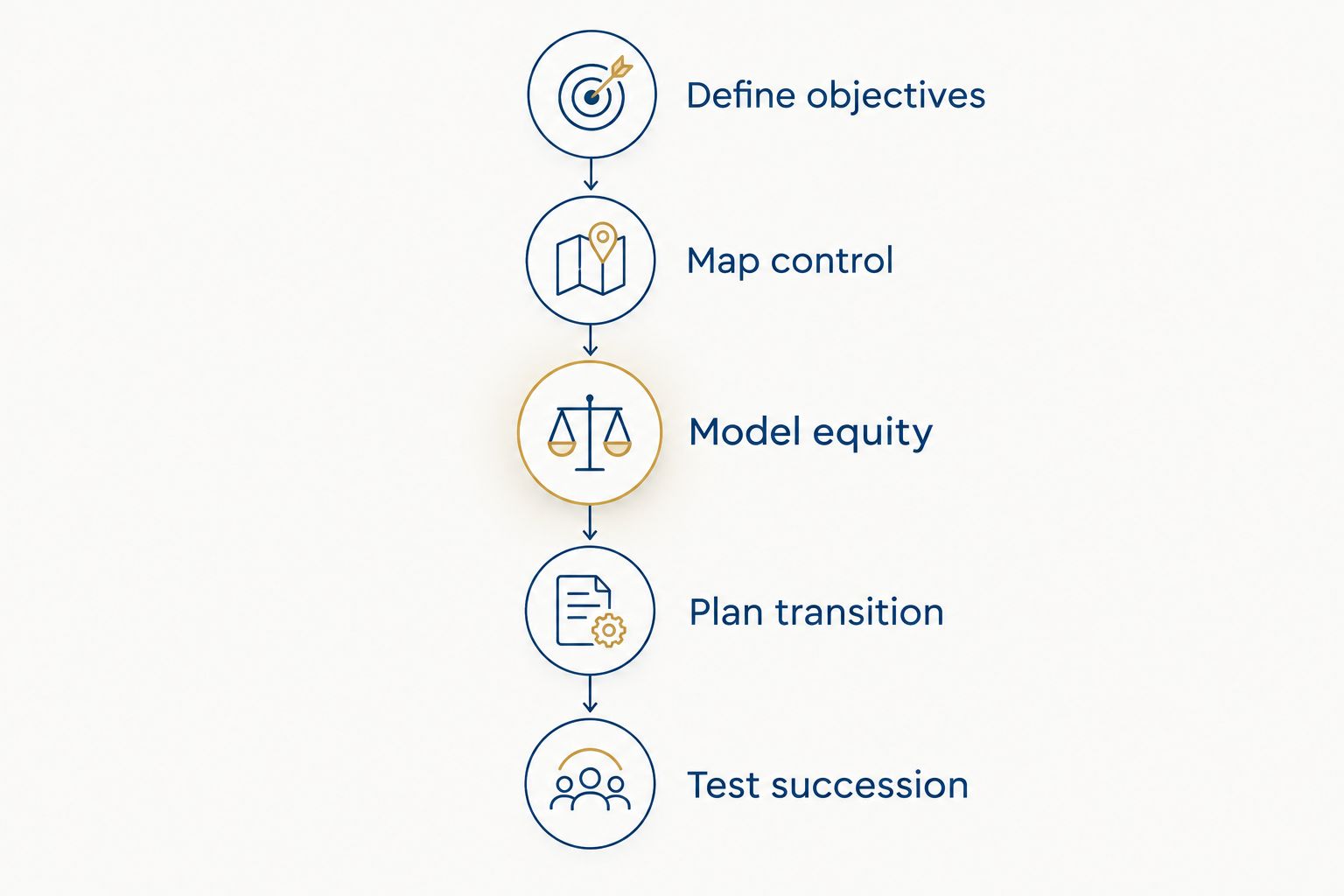
The strongest proposal is the one that satisfies your requirements across these steps. A favorable answer on valuation does not offset an unacceptable answer on control or succession.
Clarify your RIA partnership objectives
Discuss career strategy, M&A, succession planning, equity valuation, and practice growth.
Which RIA aggregator should you choose?
Start with Mercer Advisors if succession-led integration is your main objective. Start with Hightower for an investment-backed growth discussion, Focus Financial Partners for a partnership-structure comparison, or Wealth Enhancement for multidisciplinary planning coordination.
If you are undecided, do not begin by soliciting competing valuations. Define your required ownership outcome and future role first. That prevents a financial headline from deciding an operating relationship you have not examined.
FAQ
What's the best RIA aggregator for financial advisors in 2026?
The best screening choice depends on your objective: Mercer Advisors for succession-led integration, Hightower for investment-backed growth, Focus Financial Partners for partnership comparisons, and Wealth Enhancement for multidisciplinary planning. The proposed agreement, not the brand alone, determines suitability.
Is an RIA aggregator the same as an RIA custodian?
No. An RIA aggregator participates in ownership or business combinations, while an RIA custodian holds client assets and provides custody-related services. Evaluate the ownership relationship separately from custody arrangements.
Is Hightower better than Mercer Advisors?
Hightower is the more relevant starting point for an investment-backed growth discussion; Mercer Advisors is the more relevant starting point for succession-led integration. Compare the actual ownership, governance, and transition provisions before deciding.
Can I keep control after selling part of my RIA?
Retaining equity does not automatically preserve management control. Your agreement must specify voting rights, reserved decisions, approval requirements, and the authority you retain.
What should I compare besides the headline valuation?
Compare contingent consideration, rollover equity, liquidity provisions, employment obligations, and client-retention conditions. Review those economic terms alongside governance and transition responsibilities.
Does selling to an RIA aggregator solve succession planning?
A sale does not by itself complete succession planning. You still need a documented transfer of client relationships, management responsibilities, and ownership obligations that fits your intended timetable.
Should I use career strategy consulting before approaching aggregators?
Use career strategy consulting when your ownership, retirement, and practice growth objectives need to be resolved together. Intersection Advisory provides consulting for financial advisors covering M&A, succession planning, equity valuation, and practice growth.
One last thing
Ask who can approve your eventual departure before negotiating your arrival. An attractive partnership today is incomplete if the agreement leaves your future role, equity transfer, or client handoff unresolved.
For a 2026 RIA aggregator decision, the exit provisions belong in the initial evaluation—not at the end of negotiations.