
Best overall: Wealthbox CRM for day-to-day advisor workflows. Best for multi-advisor coordination: Practifi. Best for highly tailored enterprise processes: Salesforce Financial Services Cloud. Best for firms that want an established advisor-focused CRM: Redtail CRM. This 2026 guide compares the work each platform should own—and the work it should not.
- Best practice management software for financial advisors 2026: Wealthbox CRM is the default for day-to-day advisor workflows.
- Choose Practifi when coordinating work across advisors and teams is the central problem.
- Choose Salesforce Financial Services Cloud only when your firm can own a tailored implementation.
- A CRM does not replace M&A, succession planning, or equity valuation decisions.
Why this matters
Practice management software is often treated as a contact database purchase. For an advisory firm, the more consequential question is whether client work remains visible when responsibility moves between people: an advisor and an assistant, a lead advisor and a successor, or two practices combining after an acquisition.
Intersection Advisory provides career strategy consulting for financial advisors, including M&A, succession planning, equity valuation, and practice growth. Those decisions set the requirements for practice management software; the software does not make the decisions for you. A system that organizes today's follow-ups can still be a poor fit if nobody has defined who owns a client relationship after a transition.
The 2026 shortlist below separates advisor CRM, team coordination, and enterprise customization. Pick the operating problem first, then evaluate the platform. If you start with a feature demonstration, every vendor can show a useful screen. If you start with a real handoff that currently fails, you can ask each vendor to show precisely how its system handles it.
What makes the best practice management software?
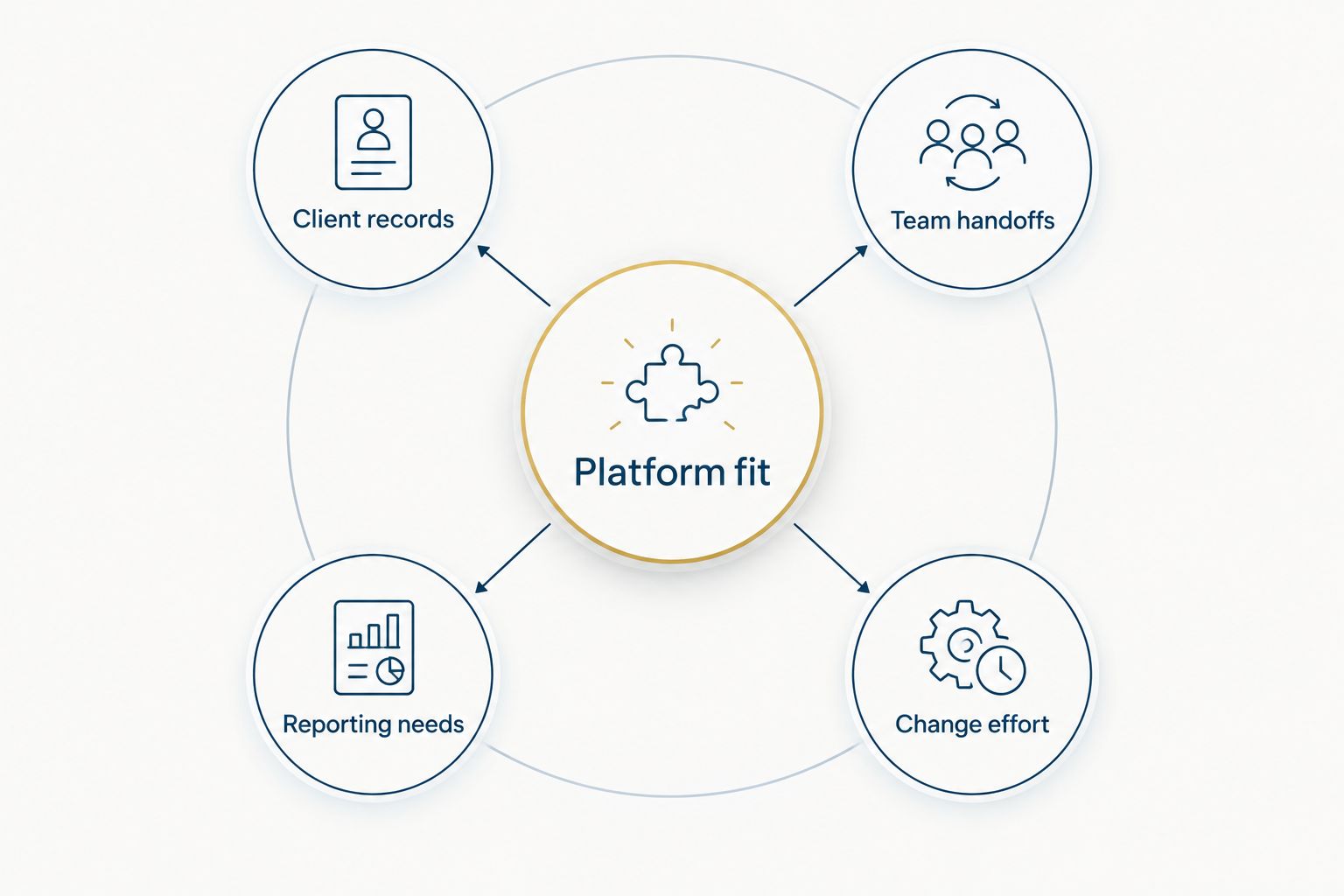
Use these criteria before comparing names. They distinguish a platform that supports your actual practice from one that simply has a long feature list.
- Client records: Can your team find the relationship history and the person responsible for the next action without reconstructing it from separate notes?
- Team handoffs: Can you assign work, identify its owner, and see what happens when that owner changes?
- Reporting needs: Can a practice leader see the status of work that matters to the firm, rather than depend on individual updates?
- Change effort: What must your firm define, configure, migrate, and maintain before the system reflects how advisors work?
- Platform fit: Is the platform meant to manage advisor relationships, coordinate broader firm operations, or support a heavily tailored enterprise process?
In 2026, give each vendor the same demonstration brief. Bring 10 sample client records with fictional details, assign work to 2 advisor roles, and request a 30-minute walkthrough of one handoff. Those are evaluation instructions, not claims about vendor capabilities. The aim is to observe what your team must do to keep a record accurate after the initial setup.
Practice management software at a glance
| Platform | Best for | Standout focus | Key limitation |
|---|---|---|---|
| Wealthbox CRM | Day-to-day advisor CRM workflows | Keeping relationship work in an advisor-focused CRM | A CRM is not a complete practice operating plan |
| Practifi | Multi-advisor coordination | Organizing work across a larger advisory team | Process design takes work before configuration helps |
| Salesforce Financial Services Cloud | Tailored enterprise processes | Configurable financial-services CRM foundation | Customization creates an ongoing ownership burden |
| Redtail CRM | Established advisor-focused CRM | Contact and relationship management for advisors | CRM records alone do not resolve transition ownership |
The default 2026 choice is Wealthbox CRM if your central problem is keeping everyday advisor work visible. That default changes when the work spans multiple teams or demands an enterprise-specific process. The table describes the decision each platform is best suited to support; it does not treat any CRM as a substitute for financial planning, portfolio management, or a succession agreement.
1. Wealthbox CRM: best for day-to-day advisor workflows
Wealthbox CRM is an advisor-focused customer relationship management platform. Put it first when the practical question is whether people working with a client can follow the relationship and its next actions in a shared system. Its place at the top of this list reflects that everyday operating need, not a claim that every advisory firm needs the same configuration.
Wealthbox CRM is the best default for a financial advisor practice that needs a shared view of routine client work. The test is whether advisors will keep that view current. During a demonstration, start with a client interaction, hand the next task to another person, and ask both users to find the status without an explanation from the original owner.
Wealthbox CRM pros:
- Its advisor-focused CRM positioning matches a firm whose first priority is managing client relationships.
- A defined daily workflow gives your team a concrete adoption test.
- You can evaluate handoffs against real client-service situations rather than a generic feature checklist.
Wealthbox CRM cons:
- A CRM does not decide which advisor should inherit a relationship during succession planning.
- Firms seeking a single system for every practice function still need to define what remains outside the CRM.
Best for: An advisory practice whose immediate need is consistent handling of contacts, client activity, and follow-up work. Before making it your standard, document who enters updates, who checks assigned work, and what happens when the lead advisor is unavailable. Otherwise, even a suitable CRM becomes another place where incomplete records accumulate.
Ask to see an existing client's history, not just a new prospect entering a pipeline. That distinction matters because the value of practice management software is often tested after a relationship has become routine. If the demonstration cannot make an ordinary service handoff understandable to both people involved, keep evaluating. Verdict: Buy if day-to-day CRM adoption is the decision you need to solve first.
2. Practifi: best for multi-advisor coordination
Practifi is a platform built for wealth management and advisory operations. It belongs higher on the shortlist when the firm-wide question is how work moves among advisors and other team members, rather than whether one advisor can track a client conversation. Its strongest fit is a practice prepared to describe the process it wants the system to reflect.
For an established firm, a useful demonstration starts with a change of responsibility. Show a client relationship with a lead advisor, a supporting role, and an open service item. Then change the lead advisor and ask what each person sees, what work remains assigned, and what a practice leader can review. The point is not to demand that a platform choose a successor; it is to test whether the agreed process stays visible.
Practifi pros:
- Its wealth-management focus makes firm operations a relevant evaluation lens.
- It suits a discussion about work across roles rather than an isolated contact list.
- It gives a multi-advisor firm a clear reason to test ownership changes and oversight.
Practifi cons:
- The firm must define its roles and handoffs before a demonstration can prove fit.
- A broader operating brief adds decisions that a smaller practice might not need to make yet.
Best for: A multi-advisor practice that has documented how client work should move between people. If your firm cannot name the owner of an open task when an advisor changes roles, address that operating rule before treating a system as the fix.
In 2026, make the evaluation about the work that crosses team boundaries. Bring the people who create, receive, and oversee that work into the same demonstration. Their questions will be different, and each needs an answer grounded in the same client record. Verdict: Buy when cross-team coordination—not basic contact management—is the binding constraint.
3. Salesforce Financial Services Cloud: best for tailored enterprise processes
Salesforce Financial Services Cloud is Salesforce's financial-services CRM offering. It is the enterprise option on this list for firms that need to shape a CRM around a defined operating model. That flexibility is relevant only if the firm is willing to specify the model and maintain the resulting system.
Start with governance, not configuration. Identify who approves changes to client records, who defines a completed handoff, and who owns the process when an advisor leaves or joins. Then ask a prospective implementation team to show how the proposed design handles those rules. A screen that can be customized is not evidence that your organization has agreed on what the screen should require.
Salesforce Financial Services Cloud pros:
- Its financial-services focus makes it relevant to complex advisory CRM requirements.
- A tailored implementation can reflect a firm-specific process rather than forcing every team into a single generic workflow.
- It gives enterprise stakeholders a platform decision they can evaluate against their own governance rules.
Salesforce Financial Services Cloud cons:
- Customization creates work for the people responsible for defining and maintaining it.
- A firm without clear process ownership risks turning operating disagreements into configuration requests.
Best for: An advisory organization with a documented process, accountable system owners, and a reason to tailor its financial-services CRM. A small practice seeking a straightforward shared record should not treat configurability as a benefit by itself.
For a 2026 selection, request a 30-day pilot of one defined process only if the vendor and your team agree on the pilot scope. Review the process with the person who will maintain it after launch. If that role has no owner, defer the enterprise decision. Verdict: Hold unless your firm has both a specific customization need and an owner for the resulting system.
4. Redtail CRM: best for an established advisor-focused CRM
Redtail CRM is built around advisor customer relationship management. It is a credible shortlist option when your firm wants its practice management discussion anchored in contacts and relationship work, rather than an enterprise redesign. Compare it directly with Wealthbox CRM using the same client records and the same handoff; an uneven demonstration will not tell you which is the better fit.
Redtail CRM is especially relevant when an advisory firm already knows the CRM job it needs done. Write that job down in plain terms: record a client interaction, identify the next owner, and retrieve the history when someone else takes over. Do not let a discussion of additional systems distract from whether the core record remains useful to the people serving the client.
Redtail CRM pros:
- Its advisor-specific CRM focus aligns with relationship-management needs.
- Its narrower evaluation brief helps a firm concentrate on the daily record and follow-up process.
- It offers a direct alternative to Wealthbox CRM for a like-for-like advisor CRM assessment.
Redtail CRM cons:
- A contact record cannot settle disputes about relationship ownership after an advisor departure.
- Firms seeking broader operational coordination must assess that requirement separately from basic CRM fit.
Best for: A firm prioritizing an advisor-focused CRM and ready to compare daily workflows against Wealthbox CRM. Name the people who must use the record, not just the leader signing off on the selection. If those users cannot find and update the information they need, the platform choice will not solve the handoff problem.
In 2026, evaluate Redtail CRM on an existing client case with an incomplete task. Have another team member take responsibility and explain the next action from the record alone. Verdict: Buy if that advisor CRM workflow fits your team better than the Wealthbox CRM alternative.
How these platforms were ranked
This ranking weights the operating problem a financial advisor practice is trying to solve: routine CRM use, coordination across advisors, tailored enterprise processes, or an established advisor-focused CRM. It does not claim that one vendor wins every feature comparison, and it does not treat a demonstration as proof of long-term adoption.
Use the same evaluation sequence for each shortlisted platform: define the work, show a real handoff with fictional client details, ask another user to recover the status, and identify who will maintain the process. Record what the demonstration establishes and what it leaves unanswered. That produces a decision your team can explain without relying on a feature count.
Which practice management software should you choose?
Choose Wealthbox CRM as the 2026 default when your firm needs an advisor-focused CRM for everyday relationship work. Choose Practifi if the central problem is coordinating work across a multi-advisor team. Choose Salesforce Financial Services Cloud only when you have a defined enterprise process and ownership for configuration. Choose Redtail CRM when its handling of your daily advisor CRM workflow fits your team better than Wealthbox CRM.
Keep software selection separate from career and practice strategy. Intersection Advisory advises financial advisors on M&A, succession planning, equity valuation, and practice growth; those decisions shape what a practice must track and transfer. An acquisition plan or succession plan can create new system requirements, but selecting a system does not establish the plan.
FAQ
What's the best practice management software for financial advisors in 2026?
Wealthbox CRM is the default for a practice focused on everyday advisor CRM work. Practifi is the stronger shortlist choice when coordinating work across multiple advisors is the main issue.
Is Practifi better than Wealthbox CRM for a multi-advisor firm?
Practifi is the better starting point when cross-team coordination defines the purchase. Choose Wealthbox CRM when the priority is a shared record for day-to-day advisor relationships.
When should a firm consider Salesforce Financial Services Cloud?
Consider Salesforce Financial Services Cloud when your firm needs a tailored financial-services CRM process and has an owner for its design and maintenance. Configurability alone is not a reason to choose it.
How should advisors compare Redtail CRM and Wealthbox CRM?
Give Redtail CRM and Wealthbox CRM the same client record and handoff scenario. Compare how your team records an interaction, assigns the next action, and retrieves the history.
Can practice management software handle advisor succession planning?
Practice management software can help organize relationship records and assigned work; it cannot decide a succession strategy. Define ownership and transition responsibilities before translating them into a workflow.
What should an advisor ask during a software demonstration?
Ask the vendor to show an existing client interaction, a change of task owner, and a status review by another team member. Use the same scenario across vendors so the comparison is meaningful.
Does an advisory firm need an enterprise CRM?
An advisory firm needs an enterprise CRM only when its defined processes require that level of tailoring and someone will maintain the system. A straightforward advisor CRM is the clearer starting point for routine relationship work.
One last thing
The most revealing software demonstration does not begin with a new prospect. It begins with an existing client whose next action has no clear owner. In 2026, ask another team member to take over that case using only the record in front of them. If they must ask the original advisor what happened, you have found the process to fix before committing to a platform.
Intersection Advisory's career strategy work addresses the decisions behind those handoffs, including succession planning and M&A. Define the decision and its owner first; then select practice management software that can preserve the resulting workflow.