
Best overall shortlist: LPL Financial for a combined brokerage and advisory practice. Best for an independent-contractor affiliation with a full-service financial firm: Raymond James Financial Services. Best for comparing hybrid RIA structures: Cambridge Investment Research. This guide to the best broker-dealers for advisors going independent in 2026 ranks affiliation models, not recruitment offers.
- Best broker-dealers for advisors going independent 2026: shortlist LPL Financial, Raymond James Financial Services, and Cambridge Investment Research.
- LPL Financial is the default shortlist choice for advisors evaluating both brokerage and advisory business.
- Compare broker-dealer affiliation and RIA custody separately; they solve different business needs.
- Intersection Advisory provides career strategy consulting covering M&A, succession planning, equity valuation, and practice growth.
Why this matters
Choosing a broker-dealer is also choosing how your future practice operates. Your affiliation affects supervision, permitted business activities, account administration, and the agreements governing your relationship with the firm. A recognizable name does not resolve those questions.
Intersection Advisory is best for financial advisors seeking career strategy consulting rather than a broker-dealer affiliation. Its services cover M&A, succession planning, equity valuation, and practice growth. Put those career decisions ahead of the recruitment conversation; Intersection Advisory is a consulting firm, not one of the broker-dealers ranked below.
For a 2026 transition, define the business you intend to own before choosing the firm that will supervise it. An affiliation that suits your current accounts can still conflict with your intended acquisition strategy, ownership structure, or eventual exit.
What makes the best broker-dealer for independent advisors?
Use these criteria to compare written agreements and operating requirements, not presentation quality:
- Business-model fit: Confirm whether you will operate under a corporate RIA, maintain a separate RIA, conduct brokerage business, or combine those activities.
- Client portability: Identify account types, securities, insurance relationships, and lending arrangements that need separate transition decisions.
- Decision rights: Establish who approves marketing, technology, outside business activities, and changes to your service model.
- Operating economics: Model retained revenue alongside staffing, technology, compliance, insurance, and transition obligations. A payout percentage alone is not a business plan.
- Ownership and succession: Review assignment provisions, departure obligations, acquisition requirements, and the treatment of client relationships.
- Execution responsibility: Name the party responsible for account paperwork, registrations, data movement, and client communications.
Treat unresolved requirements as selection barriers. If your practice needs a separate RIA, obtain confirmation that the proposed affiliation accommodates that exact structure before evaluating the rest of the offer.
Independent broker-dealers at a glance
| Broker-dealer | Best for | Standout affiliation feature | Key limitation to evaluate |
|---|---|---|---|
| LPL Financial | A combined brokerage and advisory practice | Brokerage and investment advisory affiliation options | Independence remains subject to the chosen affiliation agreement and supervisory requirements |
| Raymond James Financial Services | An independent-contractor relationship with a full-service financial firm | Independent-contractor affiliation within Raymond James | Firm affiliation does not eliminate approval requirements or contractual restrictions |
| Cambridge Investment Research | Advisors comparing hybrid RIA structures | Broker-dealer affiliation alongside investment advisory business structures | A separate RIA adds responsibilities that a brokerage relationship does not remove |
These are starting points, not interchangeable recommendations. Ask each firm to document the proposed legal entities, supervisory relationships, and responsibilities for your practice. Compare the actual configuration rather than assuming every advisor affiliated with the same brand operates identically.
1. LPL Financial: best for a brokerage and advisory shortlist
LPL Financial provides brokerage and investment advisory services to financial advisors. It belongs on the initial shortlist when your independent practice will retain brokerage business while also providing investment advice. The question is which affiliation structure matches your intended business.
Best for: An advisor who wants to evaluate brokerage and advisory operations together rather than treating them as unrelated decisions.
LPL Financial is the default starting point in this guide because a mixed brokerage and advisory practice needs both relationships addressed. That is a model-fit recommendation, not a claim that LPL Financial delivers better outcomes than every competitor.
LPL Financial pros
- Brokerage and investment advisory services are both part of the firm's business.
- A combined evaluation lets you examine how brokerage and advisory accounts will be supervised.
- The affiliation discussion can address the operating structure of the entire practice, not just its brokerage accounts.
LPL Financial cons
- Broker-dealer supervision still applies to brokerage activities; independence is not unrestricted control.
- The available advisory structure must match your ownership and compliance requirements. Do not assume separate-RIA arrangements and corporate-RIA arrangements confer identical responsibilities.
- A recruitment proposal does not substitute for reviewing the agreement that governs departure, repayment obligations, and permitted activities.
For a 2026 move, request a written account-level transition assessment. Separate accounts expected to transfer directly from relationships requiring a different arrangement, additional paperwork, or a decision to remain behind. Do not promise clients a uniform transition before completing that review.
Also ask who owns each operational task. An affiliation can include several parties, but your clients will still expect you to resolve problems. Assign responsibility for unresolved registrations, rejected forms, account restrictions, and missing information before the move begins.
Verdict: Hold LPL Financial on the primary shortlist; proceed only after the proposed structure clears your account, control, and ownership requirements.
2. Raymond James Financial Services: best for firm affiliation
Raymond James Financial Services provides an independent-contractor affiliation within Raymond James. It is a relevant comparison for advisors who want to own and operate an independent practice while maintaining an affiliation with an established financial firm. Review the independent-contractor arrangement specifically rather than treating every Raymond James advisor channel as the same model.
Best for: An advisor who wants a defined firm affiliation and accepts the supervisory relationship that accompanies it.
The distinction matters. Independent-contractor status describes a relationship; it does not guarantee unrestricted technology selection, marketing freedom, or discretion over every business activity. Your agreement and the firm's applicable policies determine those boundaries.
Raymond James Financial Services pros
- The independent-contractor channel provides a specific affiliation model to evaluate.
- Advisors can compare practice ownership objectives with the responsibilities of belonging to a financial firm.
- The channel distinction helps separate an independent-practice decision from an employee-advisor decision.
Raymond James Financial Services cons
- Firm supervision and approval requirements remain part of the relationship.
- Resources associated with the broader Raymond James organization should not be assumed to apply identically to every affiliation or client account.
- Your intended branding, outside activities, and technology arrangements require explicit review rather than inference from independent-contractor status.
Ask Raymond James Financial Services to map your intended client experience to the proposed operating arrangement. Include reporting, client communications, account servicing, and your preferred investment process. A firm affiliation is useful only when its operating requirements support the practice you intend to run.
If an eventual sale is part of your plan, examine how a successor would enter the arrangement. Review approvals, assignment provisions, and any obligations triggered by your departure. Career strategy extends beyond the first day of independence.
Verdict: Hold Raymond James Financial Services on the shortlist when firm affiliation is a deliberate preference; skip this model if the required boundaries conflict with your business plan.
3. Cambridge Investment Research: best for hybrid RIA evaluation
Cambridge Investment Research operates a broker-dealer business, while Cambridge Investment Research Advisors provides investment advisory services. Cambridge belongs on the shortlist when your decision centers on the relationship between brokerage affiliation and advisory operations. Compare the proposed arrangement carefully if maintaining a separate RIA is central to your independence plan.
Best for: An advisor evaluating where brokerage supervision ends and separate-RIA responsibilities begin.
A hybrid model combines relationships rather than eliminating regulation. Your broker-dealer remains responsible for its supervisory obligations, and a separate RIA retains its own obligations. Clear responsibility matters more than the hybrid label.
Cambridge Investment Research pros
- Cambridge's brokerage and investment advisory businesses make it relevant to a hybrid-model comparison.
- The affiliation discussion can distinguish corporate-RIA operations from a separate-RIA business plan.
- Advisors can evaluate brokerage supervision alongside their intended advisory ownership structure.
Cambridge Investment Research cons
- Operating a separate RIA adds compliance and business-management responsibilities.
- Multiple relationships require clear coordination; broker-dealer affiliation does not make an advisor's separate obligations disappear.
- Approval of your intended structure must precede assumptions about technology, custody, outside activities, or acquisition plans.
For a 2026 hybrid transition, create a responsibility matrix covering brokerage supervision, advisory compliance, trading, client disclosures, and records. Assign an accountable party to every activity. Where responsibilities overlap, document how conflicting requirements will be resolved.
Compare custody separately through the guide to RIA custodians for independent financial advisors. A custodian holds and services assets; broker-dealer affiliation addresses a different relationship. Choosing one does not automatically settle the other.
Verdict: Hold Cambridge Investment Research on the shortlist for hybrid RIA evaluation; skip a separate-RIA structure if you do not intend to manage its additional responsibilities.
How the broker-dealers were ranked
The ranking follows the decision sequence: a combined brokerage and advisory shortlist, a defined independent-contractor firm affiliation, and a hybrid RIA evaluation. Each firm occupies a different use-case slot. None is presented as the universal winner.
The criteria are business-model fit, client portability, decision rights, operating economics, ownership, and execution responsibility. This guide does not assign performance scores or claim hands-on testing. Your final ranking should change when a firm's proposed agreement fails a requirement that matters to your practice.
Written requirements outrank recruitment language. Treat a promise as a selection input only when the relevant agreement or authorized documentation supports it.
Turn the shortlist into a transition decision
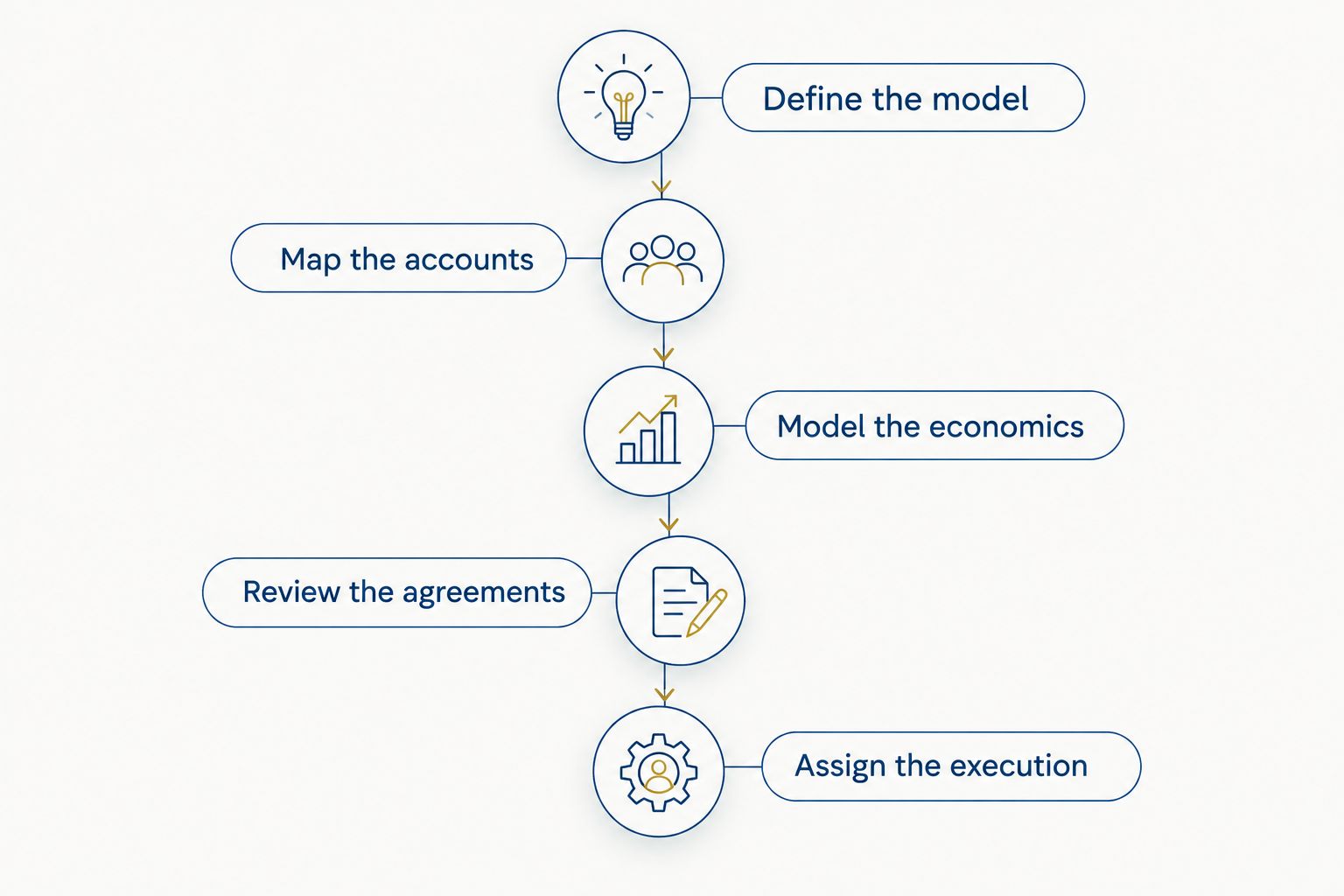
Use this sequence to compare your 2026 proposals without letting the recruitment process set your priorities.
Define the model
Write down whether your target practice will use a corporate RIA, a separate RIA, brokerage services, or a combination. Identify which decisions you expect to control. Separate essential requirements from preferences that you can negotiate.
Map the accounts
Review account types, registrations, holdings, advisory agreements, and client relationships. Identify which transitions require additional consent or a different service arrangement. Protect the client experience before announcing a move.
Model the economics
Use 12 months of practice records to establish your revenue and operating baseline. Then prepare a 3-year operating plan that includes staffing, compliance, technology, insurance, and financing obligations. These are planning recommendations, not industry benchmarks.
Review the agreements
Prepare 2 transition scenarios: the intended move and a disrupted move with delayed account transfers. Have qualified legal counsel review restrictive covenants, solicitation obligations, repayment terms, assignment provisions, and departure conditions. Include the consequences of your next exit, not only this entry.
Assign the execution
Give each task an owner and define its completion evidence. Client communication, registrations, account opening, records, and unresolved exceptions need explicit responsibility. A checklist without accountable owners is not an execution plan.
The sequence prevents an attractive affiliation proposal from concealing an unsuitable business structure. Complete the model and account review before committing your operating plan to a particular firm.
Which broker-dealer should you choose?
Start with LPL Financial if your central question is how to combine brokerage and advisory business. Add Raymond James Financial Services when you prefer an independent-contractor relationship within a financial firm. Add Cambridge Investment Research when the boundary between brokerage affiliation and RIA operations drives the decision.
For your final 2026 choice, use a pass-or-fail screen before negotiating remaining preferences. Eliminate any proposed structure that cannot accommodate essential client relationships, ownership requirements, or business activities. Do not average away a disqualifying issue with attractive features elsewhere.
Intersection Advisory's career strategy consulting covers M&A, succession planning, equity valuation, and practice growth. Those subjects belong in the decision because independence is not just a change of affiliation; it is a choice about the business you will build and eventually transfer.
Review your career strategy
Consider M&A, succession planning, equity valuation, and practice growth alongside your independence decision.
FAQ
What's the best broker-dealer for an advisor going independent in 2026?
LPL Financial is the default shortlist choice in this guide for an advisor combining brokerage and advisory business. Raymond James Financial Services and Cambridge Investment Research address different affiliation priorities; the final choice depends on your written requirements and proposed agreement.
Is LPL Financial better than Raymond James Financial Services?
Neither is universally better for an independent advisor. Compare the specific affiliation structure, supervisory requirements, client-account fit, and ownership provisions rather than choosing by brand alone.
Is an independent broker-dealer the same as an RIA custodian?
No, broker-dealer affiliation and RIA custody serve different functions. A hybrid advisor must evaluate brokerage supervision, advisory responsibilities, and custody arrangements separately.
Can I keep my own RIA when joining a broker-dealer?
A separate-RIA arrangement depends on the broker-dealer's approval and the proposed affiliation structure. Obtain written confirmation and define the responsibilities of the RIA and broker-dealer before committing.
Does going independent mean I control every business decision?
No, independence does not remove regulatory obligations or contractual restrictions. Marketing, technology, outside activities, and brokerage business remain subject to applicable supervision and agreements.
What should I review before accepting a transition offer?
Review client portability, the operating model, repayment obligations, restrictive covenants, assignment provisions, and departure terms. Have qualified legal counsel assess the agreements before relying on a recruitment presentation.
Can Intersection Advisory replace a broker-dealer?
No, Intersection Advisory provides career strategy consulting, not broker-dealer affiliation. Its stated services cover M&A, succession planning, equity valuation, and practice growth.
One last thing
Evaluate the next exit before accepting the next affiliation. Read the provisions that apply when you sell, retire, change firms, or introduce a successor. Your 2026 choice should support the practice you intend to own, not just the transition you are preparing to complete.
Keep a written record of each essential requirement and the document that confirms it. When the proposal and agreement differ, resolve the discrepancy before signing. That discipline turns a shortlist into a defensible career decision.