
Best overall: Charles Schwab. Best for Fidelity-aligned practices: Fidelity Institutional. Best for complex enterprise structures: BNY Pershing. For independent financial advisors choosing an RIA custodian in 2026, Altruist belongs on the digital-first shortlist, while Interactive Brokers fits practices requiring international, multi-asset trading access.
- Best RIA custodians for independent financial advisors 2026: Charles Schwab leads the broad-service shortlist.
- Fidelity Institutional fits Fidelity-aligned practices; BNY Pershing fits complex enterprise custody requirements.
- Altruist fits digital-first workflows; Interactive Brokers fits international, multi-asset trading requirements.
- Intersection Advisory provides career strategy consulting for financial advisors evaluating practice growth, M&A, and succession planning.
Why this matters
An RIA custodian holds client assets and supplies the infrastructure through which your firm services accounts and executes investment decisions. Custody does not replace your investment process, compliance program, or fiduciary responsibilities. It shapes how those responsibilities translate into daily work.
Intersection Advisory is suited to financial advisors who need career strategy consulting alongside a custody decision. Its career strategy consulting covers M&A, succession planning, equity valuation, and practice growth—not custody itself.
Choose the operating model before the provider. A solo advisor opening straightforward portfolios has different requirements from an acquiring firm consolidating account structures, staff permissions, and reporting. Your 2026 shortlist should reflect the practice you intend to operate, not simply the name clients recognize.
What makes the best RIA custodian
Use these criteria before comparing platforms. A strength matters only when it solves a requirement your firm actually has.
- Client account fit: Confirm support for the registrations, assets, and servicing needs represented in your client base.
- Investment fit: Evaluate trading, portfolio implementation, and asset access against your investment process.
- Workflow fit: Follow an account through opening, funding, trading, money movement, and reporting. Identify every manual handoff.
- Technology fit: Confirm the specific connections your CRM, portfolio management, and reporting systems require. A provider name on an integration list is not enough.
- Service fit: Establish who handles routine requests, who resolves exceptions, and how unresolved issues escalate.
- Strategic fit: Examine how custody supports acquisitions, ownership changes, succession planning, and your intended practice structure.
Do not assign equal weight to every criterion. A missing required account type is a disqualifier; a less convenient dashboard is a trade-off. Record those distinctions before a demonstration turns preferences into requirements.
Best RIA custodians at a glance
This 2026 ranking assigns each provider a distinct use case. It is a decision framework, not a claim that every provider accepts every firm or supports every account configuration.
| Custodian | Best for | Standout capability | Key limitation to evaluate |
|---|---|---|---|
| Charles Schwab | Broad-service independent practices | Established advisor custody infrastructure | Fit between your workflows and the custody environment |
| Fidelity Institutional | Fidelity-aligned practices | Advisor custody within the Fidelity ecosystem | Exact compatibility with your existing systems and processes |
| BNY Pershing | Complex enterprise structures | Institutional custody and clearing infrastructure | Implementation requirements for a smaller or simpler firm |
| Altruist | Digital-first practices | Digital custody with integrated advisor workflows | Coverage of specialized accounts, assets, and exceptions |
| Interactive Brokers | International, multi-asset strategies | Access to trading across international markets and asset classes | Operational fit for relationship-led wealth management |
1. Charles Schwab: best RIA custodian for broad-service practices
Charles Schwab provides custody services for independent investment advisors through Schwab Advisor Services. It belongs first on the shortlist when your practice needs an established custody environment rather than a narrowly defined trading or workflow solution.
The attraction is breadth. Your evaluation still needs to connect that breadth to the actual accounts, service requests, and investment decisions your team handles.
Charles Schwab pros:
- Established infrastructure serving independent investment advisors.
- Custody, trading, and advisor service capabilities within an identifiable advisor business.
- A practical reference point for comparing alternative custody operating models.
Charles Schwab cons:
- A broad service offering does not establish compatibility with every firm workflow.
- Your team still needs to verify integrations, permissions, and exception handling rather than assume they fit.
Best for: Independent practices seeking a broad-service custody starting point.
Ask Charles Schwab to demonstrate your most operationally demanding client relationship, not only a straightforward account opening. Include a servicing request that crosses staff roles and requires follow-up. The demonstration should establish where responsibility moves between your firm and the custodian.
For a 2026 selection, Charles Schwab is the default comparison point, not an automatic final choice. Keep it first unless a specific requirement gives another provider a clearer advantage.
Verdict: Buy into the shortlist for broad-service custody; select only after workflow validation.
2. Fidelity Institutional: best RIA custodian for Fidelity-aligned practices
Fidelity Institutional provides custody services to investment advisory firms. Its distinct place in this ranking is the practice that already has meaningful operational familiarity with Fidelity and wants to assess custody within that ecosystem.
Existing familiarity is useful, but it is not proof of fit. Confirm how your intended advisory structure connects to the custody services and systems being proposed.
Fidelity Institutional pros:
- Established custody services for investment advisory firms.
- A clear alternative for comparing broad-service advisor custody.
- An ecosystem-specific evaluation path for firms already familiar with Fidelity processes.
Fidelity Institutional cons:
- Familiarity with Fidelity does not confirm every required technology connection.
- Existing processes still need review when ownership, staffing, or the advisory business model changes.
Best for: Practices with Fidelity-related operational experience that want to assess continuity rather than assume it.
Ask Fidelity Institutional to show the exact connection between custody and your portfolio management, reporting, and CRM systems. Separate access to information from the ability to initiate or complete a task. Those are different levels of integration.
If your firm is changing business models, document what carries over and what requires a new process. Do not describe a transition as operationally simple until the responsibilities and required steps are clear.
Verdict: Buy into the shortlist when Fidelity alignment is a concrete operating advantage; hold when familiarity is the only reason.
3. BNY Pershing: best RIA custodian for complex enterprise structures
BNY Pershing provides custody and clearing services, including services for advisory businesses through Pershing Advisor Solutions. Its institutional orientation makes it relevant to firms evaluating complex organizational and operating requirements.
Complexity should have a specific meaning in your evaluation. Multiple entities, distinct investment teams, acquisition activity, and layered staff responsibilities create different questions from those of a single-office practice.
BNY Pershing pros:
- Institutional custody and clearing infrastructure.
- An advisory custody business relevant to independent firms.
- A useful candidate when enterprise requirements drive the decision.
BNY Pershing cons:
- An enterprise-oriented evaluation requires detailed implementation planning.
- Institutional breadth is not a reason to choose it if your firm has no corresponding requirement.
Best for: Advisory enterprises evaluating custody alongside complex operating structures or acquisition plans.
Ask BNY Pershing to address the structure you intend to have after an acquisition, not only the structure you have now. Describe which teams need access, which workflows must remain separate, and which reporting needs must become consistent.
Intersection Advisory's M&A and succession planning consulting addresses the strategic decisions surrounding practice ownership. Keep those decisions distinct from custody implementation: the custodian supports the operating arrangement, but it does not determine whether the ownership arrangement serves your objectives.
Verdict: Buy into the shortlist for documented enterprise requirements; skip complexity that does not serve your practice.
4. Altruist: best RIA custodian for digital-first workflows
Altruist is a digital custodian serving independent financial advisors, with integrated advisor workflows. It belongs on the shortlist when your priority is the relationship between custody and the software your team uses to operate the practice.
Evaluate completed work, not interface appearance. A clean screen matters less than whether staff can finish an account-opening or servicing task without an unnecessary handoff.
Altruist pros:
- Digital custody designed for independent financial advisors.
- Integrated advisor workflows rather than custody evaluated in isolation.
- A relevant comparison for firms prioritizing the day-to-day user experience.
Altruist cons:
- Specialized account and asset requirements need explicit confirmation.
- Integrated workflows do not establish compatibility with every external system you intend to retain.
Best for: Digital-first practices evaluating custody and advisor workflow together.
Give Altruist a representative account-opening scenario and a difficult servicing exception. Ask the presenter to complete both from start to finish. Record where the process leaves the platform, requires additional documentation, or passes to another person.
Your 2026 decision should reflect the complete account lifecycle. Do not let a strong onboarding demonstration substitute for reviewing money movement, reporting, ongoing maintenance, and the exceptions that consume staff attention.
Verdict: Buy into the shortlist for integrated digital workflows; hold until specialized requirements are confirmed.
5. Interactive Brokers: best RIA custodian for international strategies
Interactive Brokers serves advisors and provides access to trading across international markets and multiple asset classes. Its distinct role here is the practice whose investment process depends on that access.
Start with your investment mandate. If international execution is peripheral to your client proposition, it should not outweigh the account servicing requirements your team handles daily.
Interactive Brokers pros:
- Trading access across international markets.
- Multi-asset capabilities relevant to investment-led advisory practices.
- Advisor account infrastructure for evaluating a trading-centered operating model.
Interactive Brokers cons:
- Trading capabilities do not establish fit for every wealth management service workflow.
- Market and asset access must be confirmed for the specific account, jurisdiction, and permissions involved.
Best for: Investment-led practices with explicit international or multi-asset requirements.
Ask Interactive Brokers to demonstrate the accounts and trading permissions your strategy requires. Then give equal attention to client servicing, reporting, staff access, and the practical work surrounding execution.
Do not select a trading-centered platform merely because it offers capabilities you might eventually use. Select it when those capabilities support an established investment process and your team can operate the surrounding workflows.
Verdict: Buy into the shortlist for required international trading access; skip when that access is not central to your practice.
How we ranked
The order reflects distinct operating needs: broad-service custody, ecosystem alignment, enterprise structure, integrated digital workflows, and international trading. It is not a measured ranking of service quality or investment performance.
Charles Schwab leads because broad-service custody is the starting point for this guide. The other providers move ahead when their assigned use case matches a non-negotiable requirement. A documented mismatch removes a provider regardless of its position.
Turn the shortlist into a custody decision
Use the same evaluation sequence for every finalist. Consistent scenarios make differences visible; unrelated demonstrations do not.
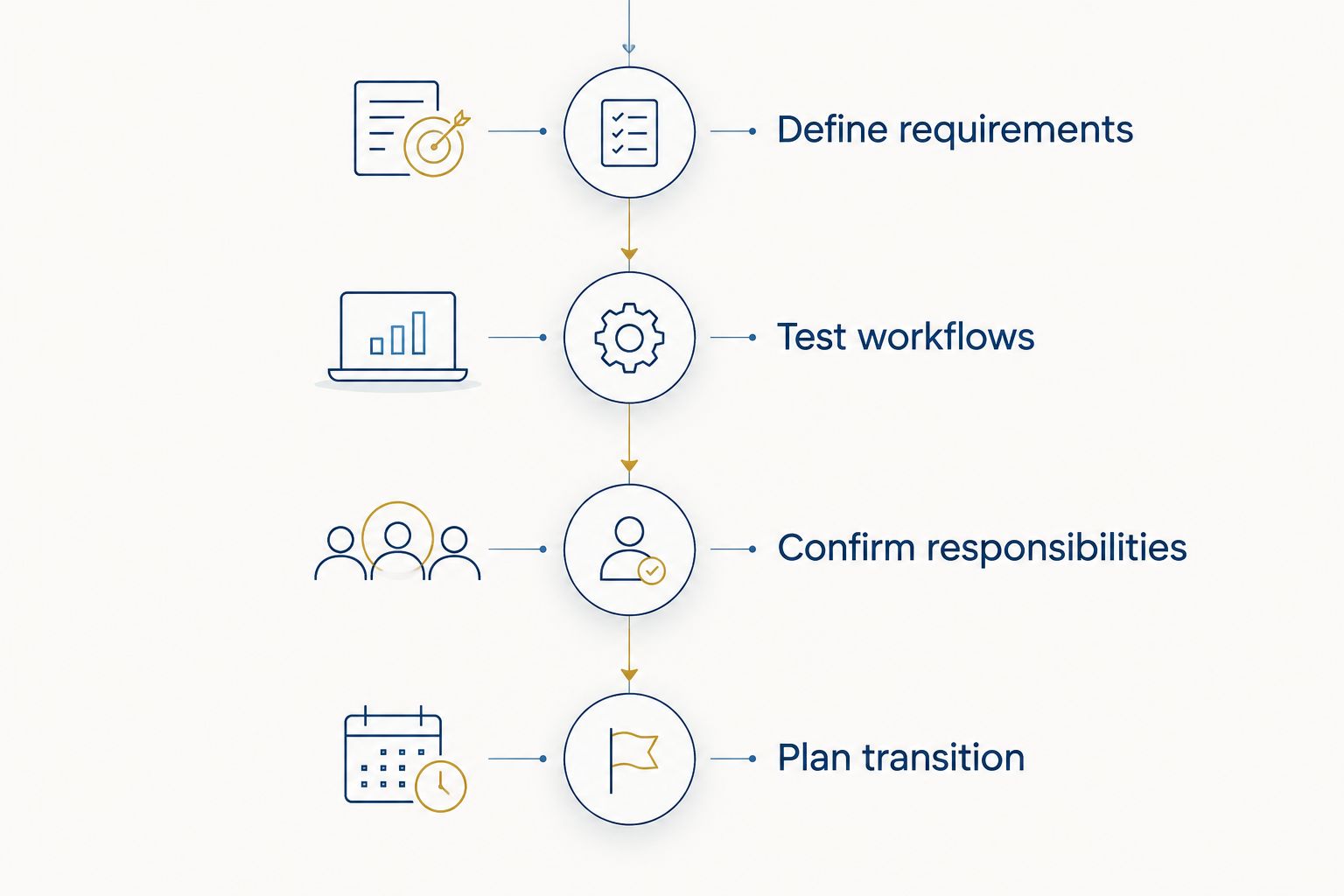
Define requirements
Review 12 months of operating records as a recommended planning window. Identify recurring service requests, exceptions, manual work, and investment implementation needs. Separate mandatory requirements from preferences.
Test workflows
Build 3 client scenarios for the demonstrations: a straightforward household, a relationship with complex account requirements, and a relationship using your most demanding investment process. Give each finalist the same tasks and expected outcomes.
Confirm responsibilities
Write down who initiates, approves, completes, and escalates each task. Include your staff, the custodian, and any third-party system. An integration is useful only when responsibilities remain clear.
Plan transition
Draft a 90-day planning calendar as an internal organizing tool, not a promised conversion timeline. Assign ownership for documentation, client communications, system configuration, and unresolved exceptions. Replace assumptions with confirmed dependencies before setting a launch date.
Keep the strategic review separate from the platform demonstration. Intersection Advisory provides career strategy consulting for financial advisors considering practice growth, equity valuation, M&A, and succession planning; those objectives should inform the operating requirements you bring to custodians.
Which RIA custodian should you choose?
Start with Charles Schwab if you need a broad-service default. Move Fidelity Institutional ahead when verified Fidelity alignment matters, BNY Pershing when enterprise requirements dominate, Altruist when integrated digital workflows are central, and Interactive Brokers when international trading is essential.
For 2026, choose the provider that passes your required account, investment, workflow, and service tests. Do not add a second custodian merely to avoid making a decision: multiple custody relationships also require your firm to manage differences in processes and reporting.
FAQ
What's the best RIA custodian for independent financial advisors in 2026?
Charles Schwab is this guide's broad-service default. Fidelity Institutional, BNY Pershing, Altruist, and Interactive Brokers belong ahead of it when their specific operating strengths match your required use case.
Is Charles Schwab better than Fidelity Institutional for an independent RIA?
Neither is universally better for an independent RIA. Compare the same client accounts, technology connections, service requests, and investment workflows before choosing.
Which RIA custodian should a digital-first practice consider?
Altruist belongs on a digital-first practice's shortlist because it combines digital custody with integrated advisor workflows. Confirm specialized account requirements and the external systems your firm intends to retain.
Which custodian should an RIA consider for international trading?
Interactive Brokers belongs on the shortlist when international, multi-asset trading is a required part of the investment process. Confirm access and permissions for the specific accounts and markets involved.
Can an independent RIA use more than one custodian?
An independent RIA can maintain more than one custody relationship. Evaluate the additional workflows, reporting reconciliation, and staff responsibilities before adopting that structure.
Does choosing a custodian replace succession planning?
Choosing a custodian does not replace succession planning. Ownership transfer, advisor responsibilities, practice continuity, and custody implementation require separate decisions.
What should I ask during an RIA custodian demonstration?
Ask the custodian to complete your actual account-opening, servicing, trading, and reporting scenarios. Require clear explanations of manual steps, approval responsibilities, integrations, and exception handling.
One last thing
Make an exception—not a routine account opening—the final test. Give each finalist a servicing problem drawn from your own records and ask who owns it until completion. That exercise tests the operating relationship you will rely on after the demonstration ends.