
Best overall approach: an integrated portfolio platform. Best for client communication: a reporting-led platform. Best for a narrow operating scope: custodian-led tools. This 2026 guide connects software selection with practice growth, succession planning, and M&A—the career strategy questions addressed by Intersection Advisory.
- For best portfolio management software for financial advisors 2026, start with operating needs, not a vendor shortlist.
- Integrated portfolio platforms are the default selection path when reporting, portfolio records, and trading require coordination.
- Reporting-led platforms suit client communication priorities; rebalancing-led platforms suit investment implementation priorities.
- Intersection Advisory provides career strategy consulting for financial advisors facing practice growth, succession planning, equity valuation, and M&A decisions.
Why this matters
Portfolio management software belongs in your operating model, not just your technology inventory. Your selection should reflect who makes investment decisions, who maintains account records, and who explains results to clients. A feature list does not answer those questions.
For an established advisor, the decision also intersects with ownership. An acquisition, partner transition, or move to independence changes the requirements you need to evaluate. Choose the operating model before choosing the software.
These rankings compare 5 selection paths rather than treating every platform as interchangeable. Each path addresses a different primary need. Use the ranking to define your shortlist, then require vendors to demonstrate the workflows your practice actually uses.
What makes the best portfolio management software?
Evaluate portfolio management software against these criteria before reviewing a demonstration:
- Portfolio records: Identify the source of positions, transactions, account classifications, and household relationships. Require a clear process for resolving discrepancies.
- Investment implementation: Define how models become proposed trades, who reviews exceptions, and who approves execution. A model library alone does not establish that workflow.
- Client reporting: Specify the performance presentation, household views, and supporting explanations your advisors need. Review the output, not just the dashboard.
- Operating ownership: Name the person responsible for reconciliation, configuration, permissions, and vendor escalation. Software does not remove those responsibilities.
- Transition readiness: Examine data exports, historical records, and compatibility with your intended custodian or acquiring firm's environment.
- Practice direction: Tie the selection to practice growth, succession planning, or M&A. Avoid making a long-term operating decision around a short-term inconvenience.
For your 2026 shortlist, separate required capabilities from preferences. A requirement is something your practice cannot operate without; a preference is something you can exchange for a better fit elsewhere. Keep those categories distinct throughout the evaluation.
Portfolio management software approaches at a glance
| Rank and approach | Best for | Standout selection priority | Key limitation to investigate |
|---|---|---|---|
| 1. Integrated portfolio platform | Coordinating portfolio operations | Connected records, reporting, and investment workflows | Whether the connection works across your actual systems |
| 2. Reporting-led platform | Improving client communication | Clear household and performance reporting | Whether trading needs require a separate system |
| 3. Rebalancing-led platform | Standardizing investment implementation | Model, exception, and trade-review workflows | Whether reporting meets client-service requirements |
| 4. Complex-wealth platform | Organizing varied holdings | Asset coverage and consolidated views | How records enter the system and remain current |
| 5. Custodian-led tools | Keeping a focused operating scope | Fit with a selected custodial environment | Whether coverage extends to your entire practice |
The table ranks decision priorities, not verified vendor capabilities. A platform belongs on your shortlist only after its demonstration confirms the relevant requirements. Product category labels are not evidence of compatibility.
1. Integrated portfolio platform: best for coordinated operations
An integrated portfolio platform is the default selection path when your practice needs portfolio records, reporting, and investment implementation to work together. Evaluate the connections between those functions rather than judging each screen separately. The decisive question is whether staff can complete a workflow without rebuilding the same information elsewhere.
Start with a representative household. Follow its records from data intake through reconciliation, reporting, and a proposed investment change. Ask the vendor to show where the workflow crosses into another application and who owns that handoff.
Integrated portfolio platform pros:
- Puts connected operating workflows at the center of the selection.
- Creates a common evaluation framework for investment and client-service teams.
- Makes duplicated data entry and manual handoffs visible during demonstrations.
Integrated portfolio platform cons:
- Broad functional coverage does not establish depth in each function.
- Connections still require validation against your custodians and applications.
- A wider implementation scope creates more configuration decisions to manage.
Best for: Practices whose main problem is coordination across portfolio operations, rather than a single missing capability.
For a 2026 decision, document the full workflow before comparing individual features. An integrated platform is not the right default if its weaker function is your practice's central requirement.
Verdict: Buy only after the connected workflow passes your practice's demonstration requirements.
2. Reporting-led platform: best for client communication
A reporting-led selection starts with what clients and advisors need to understand about portfolios. The focus is performance presentation, household organization, and explanations that support review meetings. It is a distinct path from selecting primarily for trade generation.
Bring representative reporting questions to the demonstration. Ask how the system handles account-level and household-level views, and how staff investigate an unexpected result. A polished presentation is insufficient if the team cannot explain the records behind it.
Reporting-led platform pros:
- Keeps client-facing output central to the evaluation.
- Gives advisors a concrete way to judge reporting usefulness.
- Makes household organization and report preparation explicit requirements.
Reporting-led platform cons:
- Reporting strength does not establish trading capability.
- Attractive output does not prove that underlying records are correct.
- Separate investment systems require clear responsibility for data handoffs.
Best for: Practices where the primary operating need is explaining portfolio results consistently to clients.
Request both the finished report and the process used to produce it. Your staff must understand how corrections flow through to the final output, not simply where to download a document.
Verdict: Buy when reporting is the priority and investment implementation already has a defined home.
3. Rebalancing-led platform: best for investment implementation
A rebalancing-led selection begins with the process of turning investment policy into proposed portfolio changes. Evaluate model assignment, restrictions, exceptions, review, and approval. The purpose is to establish a controlled investment workflow, not merely to generate a trade list.
Use 3 workflows in the demonstration: assigning a model, handling an exception, and reviewing proposed trades. These are evaluation exercises, not performance benchmarks. Require the vendor to show what staff see when a proposed action cannot proceed normally.
Rebalancing-led platform pros:
- Focuses the selection on repeatable investment decisions.
- Gives model oversight and exception handling explicit attention.
- Makes trade-review responsibilities part of the operating design.
Rebalancing-led platform cons:
- Investment workflow fit does not establish client-reporting fit.
- Model configuration requires documented ownership and review.
- Exceptions still need a decision-maker; software is not that decision-maker.
Best for: Practices whose central need is consistent implementation of an established investment process.
Keep the distinction between policy and execution clear. Your investment policy determines the intended action; the software workflow should support implementation and review. Do not treat the demonstration as a substitute for defining that policy.
Verdict: Buy when implementation is the bottleneck and reporting responsibilities are already resolved.
4. Complex-wealth platform: best for varied holdings
A complex-wealth selection starts with the assets your practice must represent and explain. Define the required coverage before discussing dashboards. Ask how each holding enters the system, how its value is updated, and how its record appears in consolidated reporting.
Distinguish recorded information from automatically supplied information. A consolidated view can contain records with different update processes. Your team needs to understand those differences before using the view in a client discussion.
Complex-wealth platform pros:
- Makes asset coverage the first selection requirement.
- Encourages explicit treatment of different record sources.
- Connects consolidated views with the underlying maintenance process.
Complex-wealth platform cons:
- Broad asset representation does not mean every record updates automatically.
- Different sources require clear responsibility for corrections.
- Consolidation alone does not establish trading or reconciliation capability.
Best for: Practices where varied holdings make a conventional account view insufficient for client discussions.
For 2026 planning, ask for a demonstration built around your actual asset categories. A generic example cannot establish how the platform will represent the holdings that create your operating difficulty.
Verdict: Buy only after asset coverage and record-maintenance responsibilities are demonstrated.
5. Custodian-led tools: best for a focused operating scope
A custodian-led approach evaluates the tools associated with your selected custodial environment before adding another portfolio platform. It fits a decision process centered on a defined account scope. The first question is coverage, not the number of available features.
Map which accounts, records, reports, and investment activities the tools must support. Then identify anything outside that scope. This approach loses its simplicity if staff must repeatedly assemble a practice-wide view by hand.
Custodian-led tools pros:
- Starts with the custodial environment your practice has selected.
- Encourages a disciplined assessment before adding another system.
- Keeps the initial evaluation focused on a clearly defined account scope.
Custodian-led tools cons:
- Capabilities must be checked against the specific custodial offering.
- Accounts outside the defined environment require separate evaluation.
- A future custodial change requires another operating-fit review.
Best for: Practices with a focused custodial setup and requirements that the selected tools demonstrably meet.
Do not choose this path merely to postpone a broader decision. Choose it because the account scope and operating requirements match.
Verdict: Hold off on another platform until you establish a specific capability gap.
How the selection paths are ranked
The integrated approach ranks first because it addresses coordination across the criteria. The remaining paths each prioritize a distinct requirement: communication, investment implementation, asset coverage, or custodial scope. This is a decision framework, not a claim that one vendor outperforms another.
Apply 2 decision gates before making a commitment:
- Operating fit: Can your team complete required workflows with defined responsibilities?
- Transition fit: Can your team retain the records and operating flexibility needed for its intended direction?
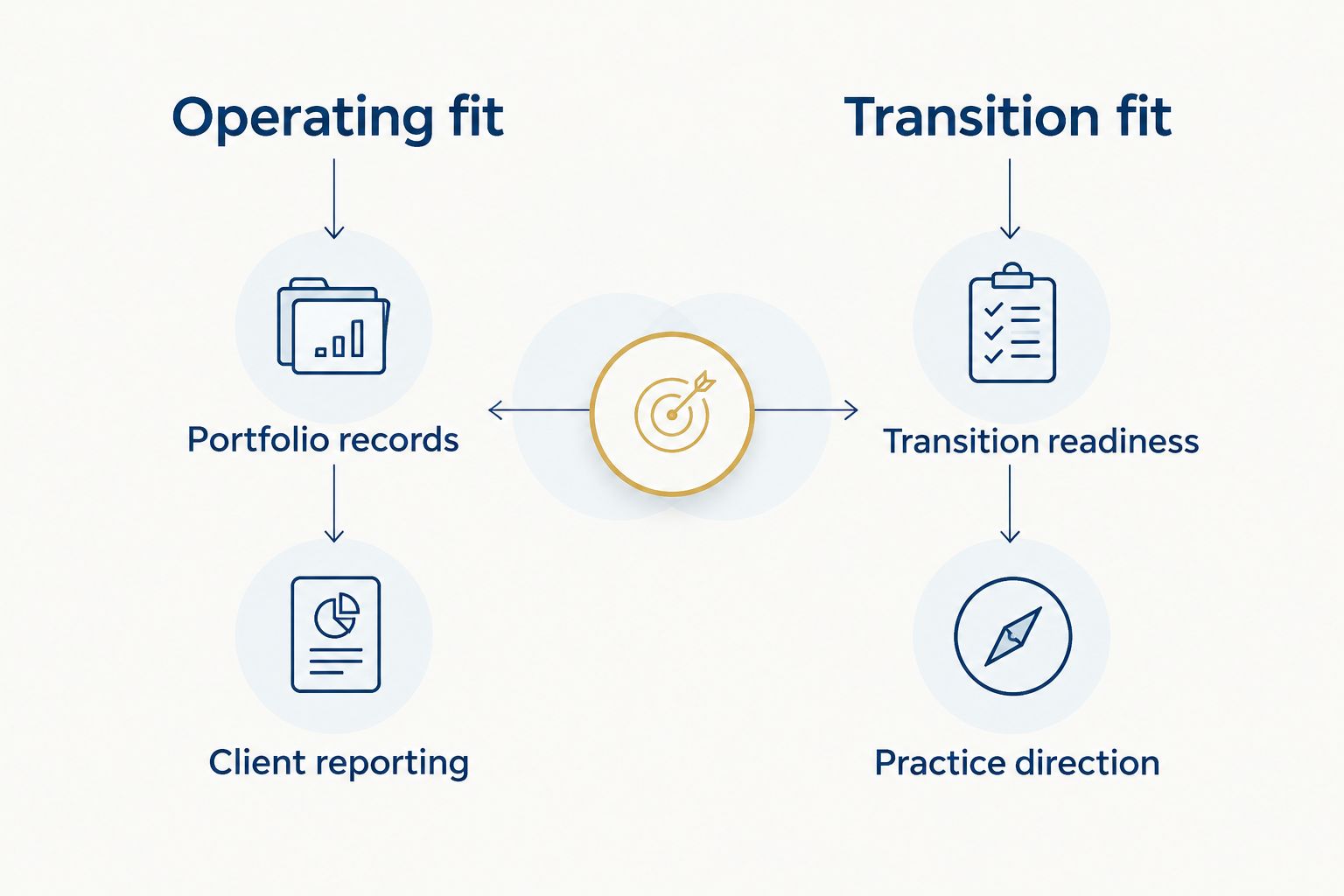
A satisfactory workflow demonstration answers only the first gate. If you are considering succession or M&A, also examine the intended future environment. Avoid committing to a migration before understanding whether another transition will follow.
Which portfolio management software should you choose?
Choose an integrated portfolio platform as the default evaluation path, then change direction when a specific requirement dominates. Select reporting-led software for client communication, rebalancing-led software for investment implementation, and complex-wealth software for varied holdings. Evaluate custodian-led tools first when your operating scope is genuinely focused.
Intersection Advisory is best suited to financial advisors seeking career strategy consulting around practice growth, succession planning, equity valuation, and M&A. That advisory role is different from supplying portfolio management software. Keep the strategic decision and the technology demonstration connected, but do not confuse them.
Before signing in 2026, name the intended operating owner, the required workflow, and the future practice direction. A selection that cannot answer those questions is not ready for commitment.
FAQ
What's the best portfolio management software for financial advisors in 2026?
An integrated portfolio platform is the default evaluation path when portfolio records, reporting, and investment implementation need coordination. Choose a more focused approach when reporting, rebalancing, varied holdings, or custodial scope is your dominant requirement.
Should I choose reporting software or rebalancing software first?
Choose reporting-led software first when client communication is your primary requirement, and rebalancing-led software first when investment implementation is the priority. Evaluate the other function separately rather than assuming it is included.
Can custodian tools replace a separate portfolio management platform?
Custodian-led tools are a suitable selection path when they demonstrably meet your account coverage and workflow requirements. Check accounts outside that environment and any practice-wide reporting needs before deciding.
What should I ask a portfolio software vendor to demonstrate?
Ask the vendor to demonstrate your actual workflow from portfolio records through review and final output. Include exceptions, corrections, and handoffs to other applications rather than reviewing only the normal path.
Should I change portfolio software before selling my advisory practice?
Establish the intended transaction and future operating environment before committing to a software migration. Review record retention, exports, and the prospective buyer's requirements as part of that decision.
Does Intersection Advisory provide portfolio management software?
Intersection Advisory provides career strategy consulting for financial advisors, covering M&A, succession planning, equity valuation, and practice growth. Its stated service is consulting, not portfolio management software.
One last thing
Ask the vendor to show a correction, not another dashboard. Follow an incorrect record through investigation, approval, and revised reporting. That exercise reveals who owns the work when the normal workflow breaks.
The useful question is not whether the software has an exception screen. It is whether your team knows what to do next.