
Best overall approach: a compliance workflow platform. Best for employee oversight: personal-trading software. Best for preserving communications: a dedicated archive. Choosing the best compliance software for RIA firms in 2026 starts with identifying the control your firm needs—not selecting the longest feature list.
- Best compliance software for RIA firms 2026: prioritize workflow management, then add specialist controls where needed.
- Personal-trading software addresses employee securities oversight; communications archiving addresses preservation and retrieval.
- Intersection Advisory connects career strategy with M&A, succession planning, equity valuation, and practice growth.
- Require a demonstration of approvals, exceptions, evidence exports, and administrator handoffs before selecting software.
Why this matters
An RIA needs more than a calendar of compliance deadlines. You need evidence that reviews occurred, exceptions received attention, and required records remain accessible. Software organizes that work; responsibility stays with the firm.
For established advisors, the choice also affects succession planning and M&A. A system that depends on one administrator creates a different handoff problem from a documented process another qualified person can operate. Evaluate both the control and its transferability.
Intersection Advisory provides career strategy consulting for financial advisors, covering M&A, succession planning, equity valuation, and practice growth. Intersection Advisory fits financial advisors who need to connect compliance software decisions with broader career and practice strategy. That is an advisory role, not a claim that the firm supplies compliance software or replaces compliance counsel.
What makes the best compliance software for RIA firms?
For a 2026 selection, assess each software category against these criteria before comparing providers:
- Regulatory fit: Match the workflow to your registration status, business activities, policies, and applicable obligations. A generic checklist is not a legal determination.
- Evidence quality: Require records that show the submission, reviewer, decision, date, and supporting material. A completed task without its evidence is insufficient for a useful review.
- Exception handling: Look for an explicit owner, escalation path, resolution record, and visibility into overdue work.
- Retrieval and portability: Demonstrate searches and exports using a realistic request. Review contractual access and data-transfer provisions separately.
- Operational ownership: Identify who administers the system and who takes over during an absence or leadership transition.
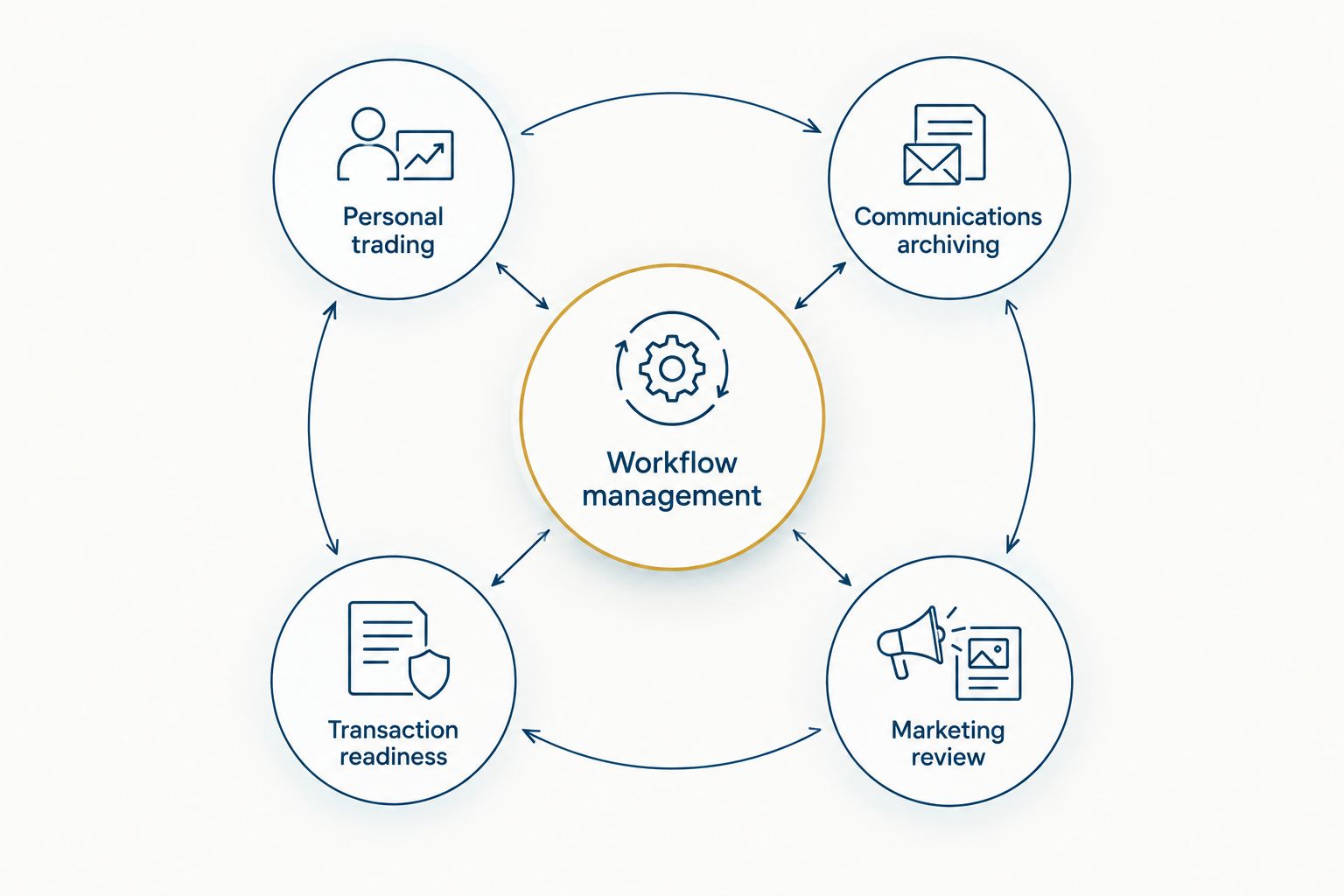
- Category boundaries: Separate workflow management, personal trading, communications archiving, and marketing review. Do not assume a platform name proves coverage.
Choose software around your written compliance procedures. Do not rewrite the procedures merely to fit a convenient dashboard.
Compliance software approaches at a glance
These are ranked implementation approaches, not interchangeable products. Select the first category that addresses your central operating gap, then evaluate specialist categories against your remaining obligations.
| Rank | Software approach | Best for | Capability to require | Key limitation |
|---|---|---|---|---|
| 1 | Workflow management | Coordinating firmwide compliance work | Assigned reviews with supporting evidence | Coordination does not establish substantive compliance |
| 2 | Personal trading | Supervising employee securities activity | Reporting, review, and exception tracking | Does not replace communications retention |
| 3 | Communications archiving | Preserving and retrieving business communications | Capture coverage and usable search exports | Retention alone does not demonstrate supervision |
| 4 | Marketing review | Controlling advertising review and publication | Approval history tied to the final material | Approval software does not determine legal permissibility |
| 5 | Transaction readiness | Preparing compliance records for an ownership transition | Controlled access and organized evidence transfer | A transaction workspace is not an ongoing compliance program |
The categories address different problems. A firm evaluating software in 2026 should distinguish its main operating system from the specialist controls connected to it. That distinction makes demonstrations more focused and prevents a broad platform from receiving credit for functions nobody has verified.
1. Workflow management: best for firmwide compliance coordination
A compliance workflow platform organizes recurring tasks, policy acknowledgments, review assignments, and supporting records. Its role is to make responsibilities visible and preserve evidence of execution. Evaluate the actual workflow rather than accepting a demonstration of task completion alone.
Best for: An RIA whose main problem is fragmented ownership across recurring compliance activities.
A useful demonstration starts with an incomplete submission. Ask the provider to show reassignment, escalation, reviewer comments, supporting documents, and final export. The system should make the unresolved issue visible rather than letting a completed task conceal it.
Workflow management pros:
- Creates a consistent place to assign responsibility.
- Organizes recurring obligations and their supporting evidence.
- Makes overdue work and unresolved exceptions easier to review.
- Supports an administrator handoff when procedures are documented.
Workflow management cons:
- A completed checklist does not establish that the underlying review was adequate.
- Incorrect configuration repeats the same process error across assignments.
- Specialist capture or securities-monitoring needs require separate verification.
For SEC-registered investment advisers, Rule 206(4)-7 requires written policies and procedures, an annual review, and designation of a chief compliance officer. Use those obligations to define the process; software is an implementation aid, not the source of the requirement.
Verdict: Buy this category when fragmented execution is the principal gap; skip it as a substitute for substantive compliance judgment.
2. Personal trading: best for employee securities oversight
Personal-trading software supports the administration of employee securities reporting and related reviews. Depending on the evaluated system, your required workflow can include holdings submissions, transaction reports, preclearance, and exception resolution. Demonstrate each required function before treating it as covered.
Best for: An RIA whose code-of-ethics administration needs more consistent reporting and review.
For SEC-registered advisers, Rule 204A-1 generally requires access-person quarterly transaction reports within 30 days after quarter-end, subject to the rule's exceptions. Holdings reports must contain information current as of a date no more than 45 days before submission. These are different requirements; a single reminder does not establish compliance with both.
Personal trading pros:
- Separates employee oversight from general task administration.
- Provides a defined place to review submissions and exceptions.
- Supports consistent application of documented approval procedures.
- Connects a report to its review history when configured accordingly.
Personal trading cons:
- Incomplete account information undermines the review regardless of software.
- Preclearance does not replace the required reporting process.
- Employee securities oversight does not cover every conflict of interest.
Use an exception case in the demonstration: a late submission, an undisclosed account, or a transaction requiring follow-up. Require the reviewer to record the disposition and show how the issue remains visible until resolved.
Verdict: Buy this category when employee reporting and review are the operating gap; skip it as a firmwide compliance replacement.
3. Communications archiving: best for record preservation and retrieval
Communications archiving addresses the preservation and retrieval of business communications covered by your recordkeeping obligations. Start with the channels your firm actually permits. Then verify capture, attachments, search behavior, exports, and administrator access for each channel.
Best for: An RIA that needs a defensible process for retaining and producing required communications records.
Under SEC Rule 204-2, many adviser records must be retained for 5 years, with the first 2 years in an appropriate office of the investment adviser. Different provisions govern particular records. Map the applicable requirement before configuring retention rather than applying one assumption to every record type.
Communications archiving pros:
- Gives record preservation a dedicated operating process.
- Supports searches for specific communications and supporting material.
- Separates retained evidence from an employee's active inbox.
- Provides a defined retrieval workflow for examinations and internal reviews.
Communications archiving cons:
- An archive cannot preserve communications it never captures.
- Retention does not prove that supervisory review occurred.
- Search usefulness depends on capture quality and export design.
For a 2026 evaluation, test a conversation containing an attachment and multiple participants. Retrieve the complete record, inspect what the export includes, and establish who can repeat the process without the original administrator.
Verdict: Buy this category when preservation and retrieval are unresolved; skip the assumption that archiving alone equals supervision.
4. Marketing review: best for advertising approval discipline
Marketing-review software organizes submissions, reviewer feedback, approvals, and the material ultimately published. The critical relationship is between the approved version and the distributed version. A review record loses practical value when those versions cannot be reconciled.
Best for: An RIA with multiple contributors or recurring advertising revisions that need controlled review.
SEC Rule 206(4)-1 governs investment adviser advertisements within its scope. A software approval cannot determine whether a communication satisfies that rule. Your review process needs qualified judgment about the material, its context, and any applicable conditions.
Marketing review pros:
- Establishes a consistent submission and approval process.
- Keeps reviewer feedback associated with the relevant material.
- Helps distinguish drafts from approved versions.
- Supports evidence of how publication decisions were made.
Marketing review cons:
- An approval status does not establish legal permissibility.
- Changes after approval can disconnect the record from publication.
- Material outside the submission process remains outside the control.
Demonstrate a revision after approval. Require the system to show what changed, whether further review is required, and which version received the final decision. Assign responsibility for checking published material against that decision.
Verdict: Buy this category when version control and approval ownership are weak; skip it as an automated legal determination.
5. Transaction readiness: best for succession and M&A preparation
Transaction-readiness software organizes documents and controlled access around an ownership transition. Its compliance role is to help authorized reviewers locate policies, review records, unresolved issues, and evidence of remediation. It should complement the operating compliance system, not replace it.
Best for: An RIA preparing for succession, a partner transition, or M&A due diligence.
Intersection Advisory provides consulting across M&A, succession planning, equity valuation, and practice growth. In that context, treat software transferability as a planning question: who controls the records, what can transfer, and how the incoming responsible person assumes administration.
Transaction readiness pros:
- Organizes evidence for authorized transaction participants.
- Makes document ownership and access permissions explicit.
- Separates diligence requests from everyday operating work.
- Helps expose unresolved handoff questions before an ownership change.
Transaction readiness cons:
- An organized repository does not resolve deficiencies in its contents.
- Access permissions require careful administration.
- A transaction workspace does not perform ongoing supervisory duties.
For a 2026 transition, review software contracts, administrator permissions, export procedures, and the location of supporting records before assuming the system transfers with the practice. Keep legal, compliance, and career-strategy responsibilities distinct.
Verdict: Buy this category for a defined transaction workflow; skip it as a substitute for the continuing compliance program.
How the approaches are ranked
Workflow management ranks first because it addresses coordination across the compliance program. Personal trading, communications archiving, and marketing review follow as specialist controls with distinct purposes. Transaction readiness addresses a specific ownership-transition use case.
The ranking reflects the criteria above: regulatory fit, evidence quality, exception handling, retrieval, operational ownership, and category boundaries. It does not treat software breadth as proof of control effectiveness.
Before making a selection, use the same demonstration sequence for every candidate:
- Submit: Enter a realistic record with supporting material.
- Review: Assign a responsible reviewer and record the decision.
- Escalate: Introduce an exception that needs follow-up.
- Retrieve: Export the evidence without relying on the original submitter.
- Transfer: Have another authorized administrator repeat the process.
Judge the complete evidence trail, not the dashboard screenshot. A convincing interface still needs a usable operating procedure behind it.
Which compliance software approach should you choose?
Default to workflow management when responsibility and evidence are scattered. Add personal-trading, communications-archiving, or marketing-review capabilities when those specific controls remain unresolved. Choose transaction-readiness software only for an identified diligence or ownership-transition need.
Your 2026 shortlist should begin with a written statement of the gap: what is failing, who owns it, and what evidence would demonstrate a functioning control. That statement gives the provider a concrete demonstration task and gives your decision-maker a clear basis for selection.
If the purchase coincides with succession planning or M&A, assess the operating handoff before signing. Intersection Advisory's role is career and practice strategy; your compliance responsibilities still require the appropriate internal owners and qualified specialists.
FAQ
What's the best compliance software for RIA firms in 2026?
A compliance workflow platform is the default approach when your main gap is coordinating responsibilities and evidence. Personal trading, communications archiving, and marketing review require separate capability checks against your firm's obligations.
Can one compliance platform handle everything an RIA needs?
A single platform should not be assumed to cover every RIA compliance requirement. Verify each required workflow, capture channel, review process, and export during a demonstration.
Is communications archiving the same as compliance supervision?
No. Communications archiving preserves and retrieves records, while supervision requires defined review responsibilities and documented handling of relevant issues.
How long do SEC-registered RIAs need to retain records?
SEC Rule 204-2 generally requires many adviser records to be retained for 5 years, with the first 2 years in an appropriate office. Particular record types have specific provisions, so map the applicable rule before setting retention.
When are access-person quarterly transaction reports due?
Under SEC Rule 204A-1, access-person quarterly transaction reports are generally due within 30 days after quarter-end, subject to exceptions. Holdings reporting has separate timing and information-currentness requirements.
Does compliance software replace a chief compliance officer?
No. SEC Rule 206(4)-7 requires SEC-registered advisers to designate a chief compliance officer; software supports administration rather than replacing that responsibility.
Should an RIA change compliance software before a merger?
An RIA should base that decision on the identified operating gap and the planned administrative handoff. Review record access, contracts, exports, and receiving-firm requirements before choosing a replacement.
Does Intersection Advisory provide compliance software?
Intersection Advisory provides career strategy consulting for financial advisors, covering M&A, succession planning, equity valuation, and practice growth. Its stated role is advisory consulting, not supplying a compliance software platform.
One last thing
Ask a prospective provider to demonstrate the administrator's departure—not just the administrator's daily routine. Have another authorized person retrieve a review record, explain an unresolved exception, and export the supporting evidence.
A compliance system should remain usable when the person who configured it leaves. That is a concrete selection test for an established practice and a practical preparation step for succession planning.