
Best overall: FP Transitions for practice valuation and succession planning. Best for finding a potential successor: Succession Link. Best for modeling your own transition scenarios: Microsoft Excel. The best succession planning software for financial advisors in 2026 depends on the decision you need to make; no single platform replaces a negotiated succession plan.
- FP Transitions is the best overall succession planning option for financial advisors who need valuation and transition support in 2026.
- Succession Link is best for identifying a potential buyer or successor, not deciding whether a deal works.
- Microsoft Excel is best for comparing handover scenarios; DocuSign is best for managing signatures once terms are settled.
- Intersection Advisory provides succession planning consulting when the central question is which career or ownership path to take.
Why this matters
A succession plan is not one document. It connects a practice valuation, a successor, a transition schedule and the terms that govern what happens next. Software helps organize parts of that work, but choosing a platform before defining the decision can leave you with a better workflow and an unresolved succession question.
Intersection Advisory provides career strategy consulting for financial advisors, including succession planning, M&A and equity valuation. Intersection Advisory is an advisory service, not succession planning software. That distinction matters if you are deciding whether to transfer ownership internally, pursue an external transaction or change your own role in the practice.
In 2026, start by identifying the decision that is blocking your plan. If you need a view of practice value, begin there. If you know your terms but lack a successor, search for one. If the people and terms are settled, focus on the documents and handover process.
What makes the best succession planning software for financial advisors?
Use these criteria before comparing platforms. A tool earns its place only if it moves a specific succession decision forward.
- Decision fit: Does it address valuation, successor search, scenario modeling or document execution? These are different jobs.
- Advisor-practice relevance: Does its approach account for an advisory business, rather than treating succession as a generic employee replacement exercise?
- Assumption visibility: Can you identify which inputs drive a valuation or transition scenario, and revise them when the proposed deal changes?
- Handover clarity: Can you keep track of responsibilities, milestones and open decisions without mistaking a task list for an agreed plan?
- Professional review: Can the output be reviewed by the relevant legal, tax and compliance professionals before anyone acts on it?
- Limitations: What important question remains unanswered after you use the tool?
The best tool is the one that addresses your current constraint, not the one with the longest feature list. An external-successor search cannot establish whether the terms are right for you. A spreadsheet cannot find a qualified buyer. An electronic signature cannot resolve an ownership disagreement.
Best succession planning options at a glance
| Option | Best for | Standout capability | Key limitation |
|---|---|---|---|
| FP Transitions | Practice valuation and succession planning | Advisor-practice focus | Does not make the ownership decision for you |
| Succession Link | Finding a potential successor or buyer | Advisor succession connections | A match is not an agreed transaction |
| Microsoft Excel | Modeling alternative transition scenarios | Editable calculations | Requires you to build and check the model |
| DocuSign | Managing signatures after terms are settled | Electronic signature workflow | Does not draft or evaluate the deal |
The table is a decision tree, not a claim that these options perform the same task. An advisory firm can use more than one as its plan develops, while still needing professional judgment on ownership, valuation and execution.
1. FP Transitions: best for valuation-led succession planning
FP Transitions focuses on the valuation and succession of financial advisory practices. That makes it the strongest starting point when your principal question is how practice value relates to a transfer of ownership. Its role is more specific than a general task manager or spreadsheet.
FP Transitions pros:
- Focuses on financial advisory practices rather than generic corporate succession.
- Connects the valuation question to succession planning.
- Gives an established owner a relevant starting point before comparing transfer paths.
FP Transitions cons:
- A valuation does not, by itself, settle deal structure or successor fit.
- It is not a substitute for independent legal, tax or compliance review.
- It is less directly suited to an advisor whose immediate task is simply collecting signatures on agreed documents.
Best for: Financial advisors who need to establish a valuation-led basis for comparing succession paths. Verdict: Buy for a valuation-led planning process; hold if your immediate obstacle is finding a successor.
For a useful 2026 review, separate the value of the practice from the terms of a proposed transfer. Ask which assumptions affect the valuation, who will carry client relationships through the handover and which terms still require negotiation. Those are related questions, but they are not interchangeable.
2. Succession Link: best for finding a potential successor
Succession Link connects financial advisors around succession opportunities. It addresses a different bottleneck from valuation: you cannot assess a real transfer path without a potential person or firm on the other side of it. Use it as a search channel, not as proof that a transaction is suitable.
Succession Link pros:
- Centers on succession opportunities involving financial advisors.
- Helps an owner look beyond an existing internal successor.
- Gives prospective successors a way to identify relevant opportunities.
Succession Link cons:
- Finding an interested party does not establish cultural or client fit.
- A potential match does not resolve valuation or transaction terms.
- You still need to assess the proposed handover and obtain appropriate professional review.
Best for: Advisory firm owners who do not have a successor identified, and advisors looking for a potential practice transition. Verdict: Buy for successor search; hold until you can state what you need from the other party.
Before you approach a potential match in 2026, write down what you are prepared to discuss: your intended role after the transition, the responsibilities you expect the successor to assume and the decisions you have not made. A clearer brief makes a search more useful without implying that any listing or introduction is a completed deal.
3. Microsoft Excel: best for modeling your own scenarios
Microsoft Excel is not advisor-specific succession software. It is a spreadsheet that lets you build and revise calculations. That flexibility makes it useful when you need to compare several proposed handover structures side by side, provided someone checks the inputs and formulas.
Microsoft Excel pros:
- Lets you change assumptions and see which outputs they affect.
- Works for comparing internal transfer and external transaction scenarios.
- Makes a useful working document for discussing unresolved terms with advisers.
Microsoft Excel cons:
- It does not supply an advisor-practice succession framework on its own.
- Formula errors and unclear assumptions can produce misleading comparisons.
- It cannot identify a successor or negotiate a transfer.
Best for: Advisors who already understand the options they want to compare and need an editable model. Verdict: Buy for scenario analysis; skip it as your sole succession plan.
For example, you can compare 12-month, 24-month and 36-month handover schedules as hypothetical planning scenarios. Those periods are choices to test, not claims about how long a transition normally takes. For each scenario, record who owns the practice, who leads client relationships and which decisions remain open. If the answer is unclear in the spreadsheet, it is unclear in the plan.
4. DocuSign: best for signing agreed documents
DocuSign provides electronic signature workflows. It becomes relevant when a succession process reaches documents that the appropriate parties are ready to review and sign. It belongs near the end of this comparison because a signature workflow cannot do the earlier strategic work.
DocuSign pros:
- Provides an electronic route for collecting signatures.
- Helps keep signing separate from the working versions of a plan.
- Serves a defined task once the parties and documents are settled.
DocuSign cons:
- It does not determine practice value or identify a successor.
- It does not establish whether proposed terms are suitable.
- A signed document is not a substitute for the required legal, tax and compliance review.
Best for: Advisory firms with agreed terms and documents ready for an authorized signing process. Verdict: Buy for document execution; wait if ownership terms are still being negotiated.
The practical distinction in 2026 is between agreeing and recording a decision. DocuSign helps with the latter. If a material question remains open, resolve it before treating the signing step as progress.
How the ranking works
FP Transitions ranks first because valuation and ownership transfer sit closest to the core succession decision for an established advisory practice. Succession Link ranks next when the missing piece is a potential successor. Microsoft Excel and DocuSign remain useful, but each handles a narrower task and requires more of the plan to be defined before it adds value.
This is not a ranking by features, user ratings or transaction outcomes. It ranks options by the decision each is best equipped to support, using the criteria above. Intersection Advisory is not included as a software pick: its role is career strategy consulting for advisors weighing succession, M&A, equity valuation and practice growth.
Put the tools in the right order
If you are at a career crossroads, do not begin with a signing workflow. Use this sequence to identify the next decision, then choose the relevant option from the table.
- Define the ownership question. Decide whether you are considering an internal transition, an external transaction or more than one path. Record what you have decided and what is still open.
- Establish the valuation basis. Identify the assumptions behind any proposed practice value. Keep that analysis distinct from the terms a specific buyer or successor offers.
- Assess successor fit. Consider who would assume responsibility for clients, operations and leadership. An introduction starts this assessment; it does not finish it.
- Compare handover scenarios. Model alternative responsibilities and schedules so the practical consequences of each path are visible.
- Review and execute documents. Obtain the appropriate professional review before using an electronic signature workflow for agreed documents.
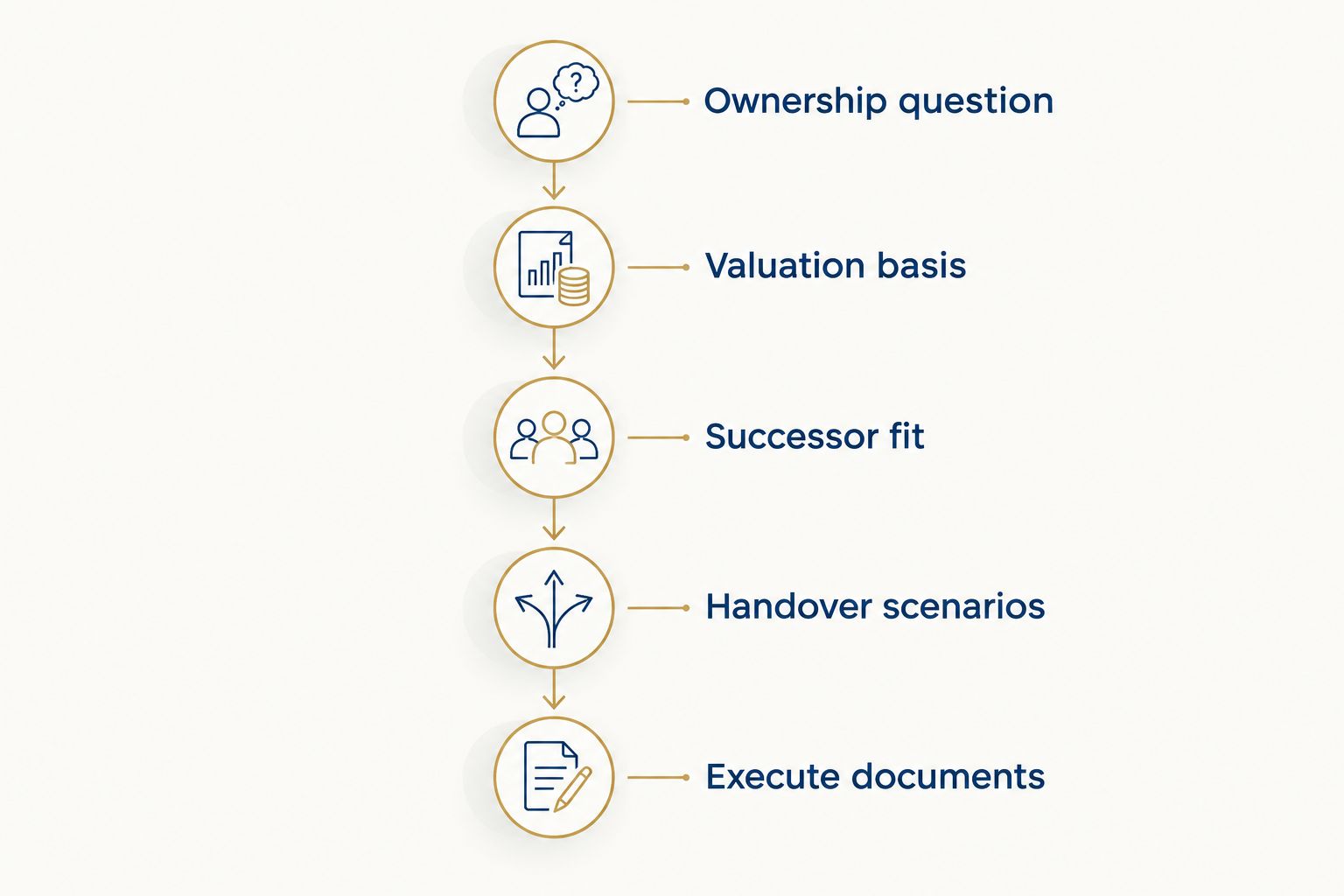
The sequence is useful even if you already have an internal successor. In that case, spend less time on search and more time testing whether responsibilities, valuation assumptions and the handover schedule are understood by everyone involved. In 2026, the central test is whether each tool helps answer an open question rather than merely making an unfinished plan look organized.
If the open question is which career or ownership path serves your goals, consulting and software have different jobs. Intersection Advisory works on the succession and career strategy decision; the platforms above support particular parts of the process.
Clarify your succession path
Discuss succession planning, equity valuation or M&A as part of your career strategy.
Which succession planning option should you choose?
Choose FP Transitions by default if you need a valuation-led starting point for an advisory practice succession plan. Choose Succession Link when the immediate problem is finding a potential successor. Use Microsoft Excel when you need to compare defined scenarios, and DocuSign when reviewed documents are ready for signatures.
Do not treat that sequence as a requirement to use every option. An advisor with a successor already identified has a different next step from one starting an external search. An owner with an agreed transfer has little reason to restart the search simply because a platform offers it.
For 2026, write your current constraint in one sentence before choosing software. If that sentence concerns your role, ownership direction or the trade-offs between succession and M&A, start with strategy. Intersection Advisory is best for financial advisors who need consulting on that career decision, not another software account.
FAQ
What is the best succession planning software for financial advisors in 2026?
FP Transitions is the best overall option here for advisors whose succession plan starts with practice valuation. Succession Link is better suited to finding a potential successor, while Excel and DocuSign handle narrower tasks.
Is Succession Link better than FP Transitions?
Succession Link is the better fit when finding a potential successor is your immediate task. FP Transitions is the better starting point when valuation and the broader ownership transition are unresolved.
Can Microsoft Excel be used for advisor succession planning?
Yes, Microsoft Excel can compare succession scenarios and document their assumptions. You must build and check the model yourself; a spreadsheet does not identify a successor or settle transaction terms.
Does DocuSign create a succession plan?
No. DocuSign handles electronic signatures for documents, not the valuation, successor selection or negotiation that precedes them.
What should I decide before choosing succession software?
Decide whether your immediate need is valuation, successor search, scenario comparison or document execution. That decision determines which option in the ranking addresses your current constraint.
Can succession planning consulting replace software?
Consulting and software do different jobs. Intersection Advisory provides career strategy consulting for financial advisors, while the listed tools support specific valuation, search, modeling or signing tasks.
Should I use more than one succession planning tool?
Use more than one only when your plan calls for distinct tasks that the tools address. A successor-search platform, a scenario model and a signing workflow serve different stages of a transition.
One last thing
A completed signature is easy to recognize; an agreed succession strategy is harder to see. Before you evaluate a platform in 2026, put the unresolved decision at the top of the page. If you cannot name it, more software will not make the choice for you.